 By
The short answer
Swing states, also called battleground states, are states where either major party can realistically win the presidential vote, so campaigns focus their time and money there. As of October 2026, the seven most analysts list are Pennsylvania, Georgia, North Carolina, Michigan, Arizona, Wisconsin and Nevada, which together hold 93 of the 538 electoral votes.

In 2016, Pennsylvania, Michigan and Wisconsin held 46 electoral votes between them. Donald Trump carried all three by a combined 77,744 votes, out of almost 14 million cast there. That is roughly the crowd at one big college football game, and it decided the election.
A presidential candidate needs 270 of the 538 Electoral College votes, and most states are not in doubt long before Election Day. So the campaigns pour their money, ads and candidate visits into the few competitive states where either party can win. Below are the seven swing states as of October 2026, with official results for each, followed by a look at two states that used to be on the list.
What makes a state a swing state?
There is no official list of swing states, known as battleground states too. Journalists, campaigns and political forecasters each draw their own, and most look for the same signs before a state is considered swing state territory:
- Close margins: the statewide presidential race is usually decided by a few points or less.
- Both parties win: the state has gone Democratic and Republican within the last few elections.
- A mixed electorate: big metro areas that tend to vote Democratic sit next to smaller towns and rural counties that tend to vote Republican, and the suburbs move between them.
- Winner-take-all stakes: in 48 states and Washington, D.C., the statewide winner gets every elector. Only Maine and Nebraska award some by congressional district. A tiny lead can deliver a large prize, as our guide to how the Electoral College works explains.
States that reliably vote one way are called safe states, or red and blue states, and these states have little reason to see a campaign bus. A campaign that already owns Wyoming or Vermont gains nothing by spending more there.
The 7 swing states, as of October 2026
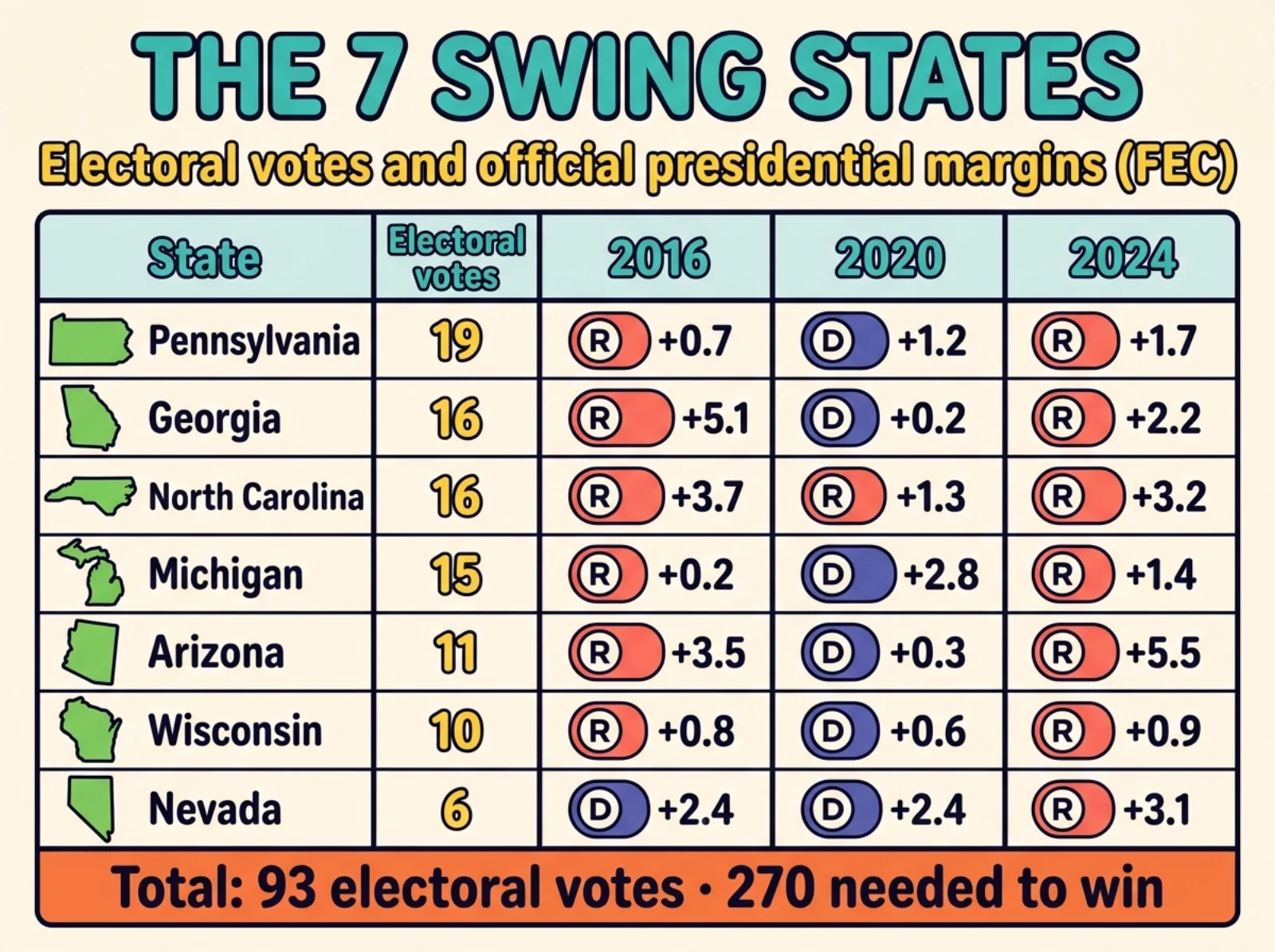
Arizona, Georgia, Michigan, Nevada, North Carolina, Pennsylvania and Wisconsin appeared on almost every list for the 2024 presidential election, and they are where most analysts expect the 2028 campaign to be fought. These states hold 93 electors between them. Margins are in percentage points from the Federal Election Commission’s official results, with the raw lead in parentheses; R means the Republican candidate led, D the Democratic one. Trump won six of the seven in 2016, Biden six in 2020, and Trump all seven in 2024.
1. Pennsylvania (19 electors)
- 2016: R +0.7 points (44,292)
- 2020: D +1.2 (80,555)
- 2024: R +1.7 (120,266)
Pennsylvania is the biggest prize on the board, which is why candidates practically rent apartments there in October. The vote is a tug of war between the Philadelphia and Pittsburgh areas and the rest of the state, with Philadelphia’s suburbs often deciding which side pulls harder.
2. Georgia (16 electoral votes)
- 2016: R +5.1 (211,141)
- 2020: D +0.2 (11,779)
- 2024: R +2.2 (115,100)
Georgia is the newest member of the club. In 2020, Joe Biden became the first Democrat to carry it since 1992, and his margin was under 12,000 votes. The vote is largely a contest between the fast-growing Atlanta metro area and the rest of the state.
3. North Carolina (16 electors)
- 2016: R +3.7 (173,315)
- 2020: R +1.3 (74,483)
- 2024: R +3.2 (183,048)
North Carolina is the outlier. It has voted Republican for president every time since Barack Obama won it in 2008, but almost always by a few points, so both campaigns keep treating it as winnable. Its growing metro areas around Charlotte and the Research Triangle pull one way, much of the rest of the state the other.
4. Michigan (15 electoral votes)
- 2016: R +0.2 (10,704)
- 2020: D +2.8 (154,188)
- 2024: R +1.4 (80,103)
Michigan produced the closest result of 2016: about 10,700 votes out of nearly 4.8 million. Union households, the Detroit suburbs and a large rural north all count here, and none of them votes as a fixed bloc.
5. Arizona (11 electors)
- 2016: R +3.5 (91,234)
- 2020: D +0.3 (10,457)
- 2024: R +5.5 (187,382)
Arizona voted Democratic in 2020 for the first time since 1996, by about 10,500 votes. Four years later it swung back by the widest margin of any of the seven. Most of its voters live in Maricopa County, around Phoenix, so the state’s result tends to follow that one county.
6. Wisconsin (10 electoral votes)
- 2016: R +0.8 (22,748)
- 2020: D +0.6 (20,682)
- 2024: R +0.9 (29,397)
If you want the purest swing state, this is it: three elections in a row decided by less than one point. Democratic-leaning Milwaukee and Madison balance a large Republican-leaning countryside, and the suburbs around Milwaukee often break the tie.
7. Nevada (6 electors)
- 2016: D +2.4 (27,202)
- 2020: D +2.4 (33,596)
- 2024: R +3.1 (46,008)
Nevada is the smallest of the seven, but in a close Electoral College count six electors can decide the outcome. Democrats carried it in every presidential race from 2008 to 2020, and Trump’s 2024 win made him the first Republican to take it since 2004. Most votes come from Clark County, home to Las Vegas.
Swing states at a glance
| State | Electoral votes | 2016 | 2020 | 2024 |
|---|---|---|---|---|
| Pennsylvania | 19 | R +0.7 | D +1.2 | R +1.7 |
| Georgia | 16 | R +5.1 | D +0.2 | R +2.2 |
| North Carolina | 16 | R +3.7 | R +1.3 | R +3.2 |
| Michigan | 15 | R +0.2 | D +2.8 | R +1.4 |
| Arizona | 11 | R +3.5 | D +0.3 | R +5.5 |
| Wisconsin | 10 | R +0.8 | D +0.6 | R +0.9 |
| Nevada | 6 | D +2.4 | D +2.4 | R +3.1 |
Electoral votes follow the 2020 Census and apply to the 2024 and 2028 elections. Swing states also matter between presidential years: Georgia, Michigan and North Carolina all have U.S. Senate seats on the ballot on November 3, 2026. Which party wins any of them in 2028 is something this page will not guess.
A few other states sit near the edge. New Hampshire (4 electors) went to Hillary Clinton by 0.4 points in 2016 and to Kamala Harris by 2.8 points in 2024. Minnesota went Democratic by 4.2 points in 2024. Both show up on some broader lists, but neither has been as competitive over the last three cycles as the seven above.

Former swing states: Ohio and Florida
Swing state lists change, and two states that used to define the term have moved off it.
Ohio (17 electoral votes) was the famous bellwether. From 1964 through 2016 it voted for the winner every single time, as the old line “as Ohio goes, so goes the nation” promised. Then the margins grew. Trump won Ohio by 8.1 points in 2016 and 8.0 in 2020, the first time since 1960 that Ohio backed the losing candidate, and by 11.2 points in 2024.
Florida (30 electoral votes) gave the country its tightest modern finish. In 2000, George W. Bush carried it by 537 votes after a recount fight that went to the Supreme Court. Florida stayed close for years: Trump won it by 1.2 points in 2016 and 3.4 in 2020, both times running ahead of his national popular vote share. In 2024 his margin reached 13.1 points, and most analysts now count it as a Republican-leaning state.
States can move onto the list too. Georgia and Arizona were in the Republican column in every presidential race from 2000 through 2016, then both flipped in 2020. A state becomes a swing state when its electorate shifts enough that the old majority is no longer safe, whether through people moving in, growing suburbs or changes in how groups of voters lean. Whoever wins the parties’ primary elections also shapes which voters are in reach.
Quick answers
What are the 7 swing states?
As of October 2026, the seven swing states most analysts list are Pennsylvania, Georgia, North Carolina, Michigan, Arizona, Wisconsin and Nevada, with 93 electoral votes in total.
Swing state, battleground state: is there a difference?
No. Swing states and battleground states are the same thing: a state either party can realistically win. News outlets use the terms interchangeably.
Why do swing states get so much attention?
Winner-take-all. A one-point win in Pennsylvania is worth the same 19 electors as a 20-point win, so the parties spend where a few thousand ballots flip a whole state. For how the two parties differ once they get there, see our Democrat vs. Republican explainer. The official certified totals for every state are published in the FEC’s federal election results.