The short answer
Primary elections decide which candidates a party sends to the November general election. Who may vote depends on the state: closed primaries are limited to party members, open primaries let any voter pick one party's ballot, semi-closed systems admit unaffiliated voters, and California, Washington and Alaska use one shared ballot where the top two (or top four in Alaska) advance. In presidential races, primaries and caucuses award delegates who formally nominate the candidate at each party's convention.

In Pennsylvania, a registered independent who shows up on primary day can’t vote in either party’s race. In Michigan, anyone can walk in, pick a Republican or Democratic ballot, and nobody asks about party. In California, everyone gets the same ballot with every candidate on it, and the two who advance may well belong to the same party. All three are primary elections, run under three different rulebooks.
There is no single national system. Each state writes its own law, and the political parties add their own rules on top, especially for the presidential election. This guide sorts out the primary systems, explains what happens after the votes are counted, and ends with a checklist. Rules are current as of October 2026.
The problem: one country, fifty rulebooks
Primary elections are the contests that decide which candidates a party sends to the general election in November. Federal primaries cover president, U.S. Senate and U.S. House; states use the same process for governor, the legislature and many local offices.
The Constitution says nothing about primaries. They spread in the early 1900s, when reformers wanted party members, not party bosses, to choose the candidates for the general election ballot. Since then each state has answered one question in its own way: who may participate in a party’s primary? Only members? Anyone? Independents but not the other party?
That answer decides whether you get a ballot at all, which is why “Can independents vote in primary elections?” has no single answer.
Types of primary elections
The National Conference of State Legislatures sorts state systems into a handful of categories. Its state primary types table is the standard reference, and it notes that these categories apply to state, local and congressional races, not always to the presidential contest.
| Type | Who can vote | Example states (NCSL) |
|---|---|---|
| Closed | Only voters registered with that party | Delaware, New York, Pennsylvania |
| Partially closed (semi-closed) | Party members, plus unaffiliated voters if the party allows it | Connecticut, Oklahoma, Utah |
| Open to unaffiliated voters | Members and independents; no crossing over | Colorado, New Hampshire, North Carolina |
| Partially open | Anyone, but the choice is public or counts as registration | Illinois, Ohio, Iowa |
| Open | Any voter picks one party’s ballot in private | Michigan, Texas, Wisconsin |
| Top-two | One shared ballot; top two advance | California, Washington |
| Top-four | One shared ballot; top four advance to a ranked-choice general | Alaska |
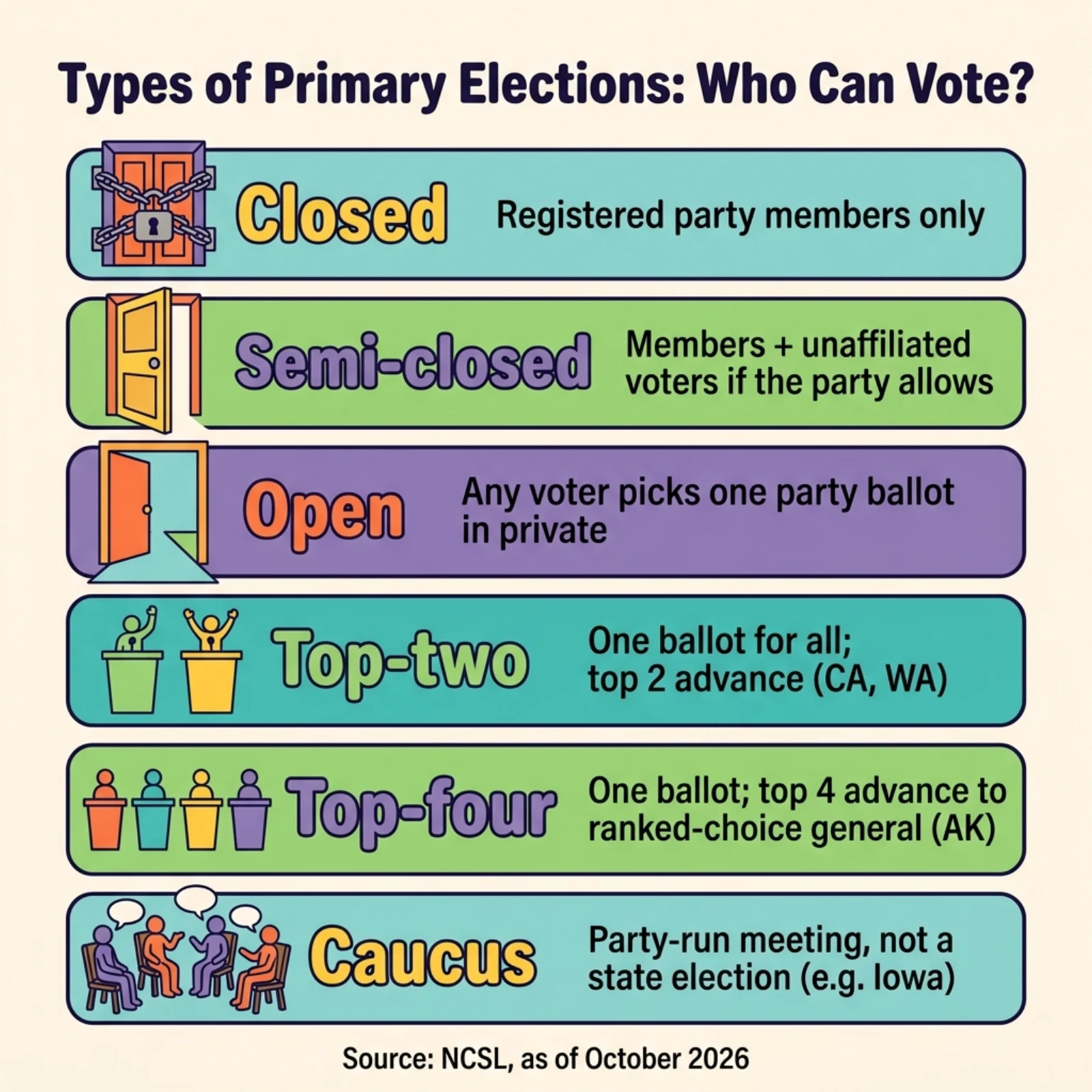
Can independents vote in closed primaries?
In a closed primary, no. The voter must be a registered member of the party holding the primary, so independents sit this one out. Supporters say party members should choose their own nominee without interference; critics point out that taxpayers who belong to no party help pay for the election.
Semi-closed systems split the difference. Unaffiliated voters may join one party’s contest, depending on state law or on what each party decides before the election. A registered Democrat still cannot vote in the Republican primary.
How do open primaries work?
In an open primary, you don’t register by party, or your registration doesn’t matter. On election day you choose one party’s ballot, privately, and you cannot vote in both the Democratic and Republican primary for the same office. Some states keep a public record of which ballot you took, the “partially open” variant. Texas adds a twist: whichever primary you vote in, you are tied to that party for any runoff.
How does a top-two primary work?
California and Washington list all candidates on one ballot with their party preference. Every voter gets the same ballot, and the top two vote-getters advance to the general election, even if both are from the same party. In California this covers state and congressional offices, not the presidential primary or county party committees, according to the California Secretary of State.
Alaska went further. Voters approved Ballot Measure 2 in 2020, creating a top-four primary: one ballot, four candidates advance, and the general election uses ranked-choice voting. A 2024 repeal effort failed by 737 votes out of about 321,000 cast. Another repeal measure is on the November 3, 2026 ballot, so the system could change soon (as of October 2026).
Primaries and caucuses: what’s the difference?
A primary is run by the state, with secret ballots cast throughout the day. Caucuses are party-run meetings at the precinct or county level. In some versions, supporters of each candidate stand in separate corners of a gym and try to recruit the undecided. It is democracy with folding chairs.
Iowa is the famous case. On January 15, 2024, the Iowa Republican caucuses opened the presidential nominating season. Iowa Democrats held in-person caucuses that night only for party business; their presidential vote ran by mail and was announced on Super Tuesday, March 5, after a compromise with the Democratic National Committee. Many states have switched from caucuses to primaries in recent cycles, mostly because primaries are easier to run and draw more voters.

Presidential primaries vs. midterm primaries
On the ballot they look alike. Underneath:
- Midterm and state primaries pick nominees directly. The candidate with the most votes usually wins, although some states, including Georgia and Texas, require a majority and hold a runoff if no one gets one.
- Presidential primaries don’t pick the nominee directly. Voters choose delegates, and those delegates vote for their preferred candidate at the national convention in the summer. The rules can differ from the state’s other primaries: California and Washington, for example, use party primaries for president.
The 2026 midterm primaries are over as of October 2026. The next presidential primaries and caucuses begin in early 2028, and the parties are still finalizing that calendar.
How delegates and superdelegates work
Each party sets its own delegate rules, and the two are far apart.
| Democratic Party | Republican Party | |
|---|---|---|
| Pledged delegates | Proportional; a candidate needs at least 15% in a state or district | Each state party chooses: proportional, winner-take-all, or a hybrid |
| Superdelegates | Party leaders and elected officials; unpledged | No equivalent bloc; each state’s three national committee members attend under state party rules |
| First ballot | Since 2018, superdelegates sit out unless a candidate already has a majority of pledged delegates | Not applicable |
Democrats adopted that superdelegate limit in August 2018, after complaints about the 2016 race. If a convention needs a second ballot, superdelegates vote too. No modern convention has needed one, so the backup plan remains untested. The parties could still adjust these rules for 2028.
After the conventions, the race moves to the general election and, for president, to the Electoral College. Our guide to how the Electoral College works covers that part.
Practical tips for primary voters
Most of the trouble comes from a few things:
- Registration deadlines come early. In closed states, you may have to register with a party weeks or months before the primary election.
- “Independent” can mean two things. Unaffiliated is different from joining a minor party with “Independent” in its name, which in a closed state can keep you out of both major primaries. Our explainer on third parties covers how those parties get on the ballot.
- Turnout is usually low, so each vote carries more weight. In districts that lean strongly toward one party, the primary is often the real contest. Knowing the differences between Democrats and Republicans helps if you have to pick a ballot.
- The presidential primary may follow other rules. Check separately, especially in California, Washington and Alaska.
Checklist: how to vote in your state’s primary
- [ ] Look up your state’s primary type on your secretary of state’s or election office website (USA.gov links to every state office).
- [ ] Check your registration, your party affiliation and the deadline to change it.
- [ ] Find the primary date, plus the runoff date if your state has one.
- [ ] Decide which party’s ballot you want, if your state asks you to choose.
- [ ] Request a mail ballot early if you need one.
- [ ] Confirm your polling place and ID rules the week before.
- [ ] In a presidential year, check whether your state holds a primary or a caucus.