The short answer
A poll tax was a flat fee citizens had to pay before they could register or vote. Southern states used it from the late 1800s, along with literacy tests and other barriers, to keep Black citizens and many poor white voters from the ballot. The 24th Amendment banned it in federal elections in 1964, and the Supreme Court's 1966 ruling in Harper v. Virginia Board of Elections banned it in state and local elections.

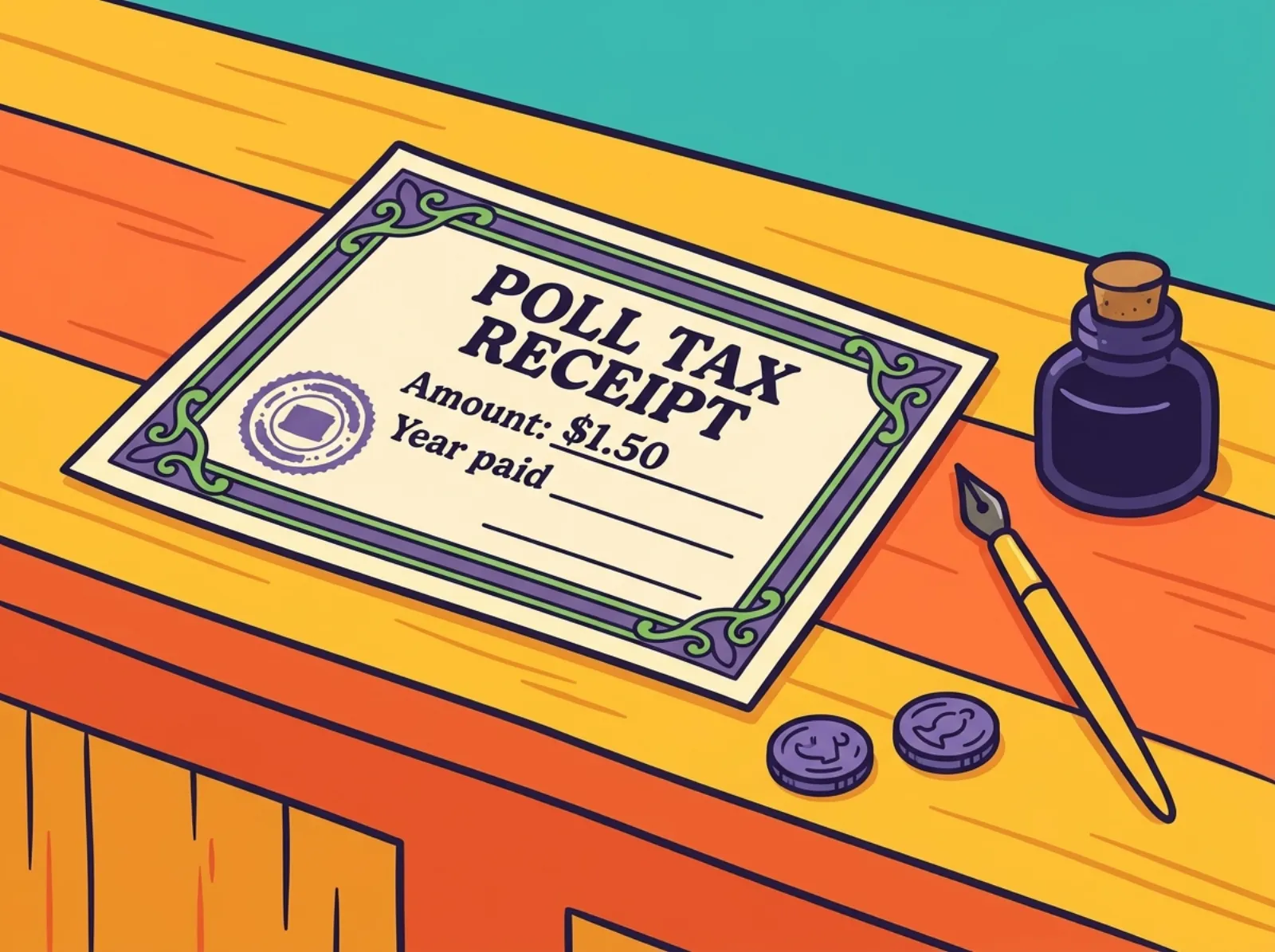
By 1964, Annie E. Harper of Virginia had a problem that sounds small. She wanted to register to vote, and the state would not add her to the rolls until she paid a poll tax. Virginia’s constitution capped it at $1.50 a year for residents 21 and older, due long before Election Day. Harper sued the Virginia State Board of Elections for herself and other poor residents. On March 24, 1966, her case ended the poll tax in American elections.
A dollar and a half sounds trivial now. Its history explains why the term still turns up in arguments about voting rules.
What a poll tax is
A poll tax is a flat fee per person, the same for a farmhand and a bank president. “Poll” is an old word for “head,” so historians also call it a head tax. As a way to raise money for government, it is simply regressive. It became a voting tool when states made payment a condition of registering or casting a ballot.
Where poll taxes in the Southern states came from
Colonial governments collected head taxes as ordinary revenue, and for a long time they did not have anything to do with voting. That changed after the Civil War. As Reconstruction ended in 1877, Southern legislatures looked for ways to keep Black men from voting without openly breaking the Fifteenth Amendment, which bars denying the vote “on account of race.”
The Library of Congress says the tax was revived after Reconstruction to restrict voting “for underprivileged people in general and African Americans in particular.” Poll taxes were rarely used alone. States stacked them with other devices:
- literacy tests, graded by local registrars,
- “grandfather clauses” that exempted men whose ancestors could vote before the war,
- the “white primary,” which closed the decisive Democratic primary elections to Black voters,
- long residency rules and, often, intimidation.
The Supreme Court approved the arrangement in Breedlove v. Suttles (1937), a challenge to Georgia’s tax. As long as that ruling stood, states could keep charging.
Who paid the price, including poor white voters
Because the law never mentioned race, it hit anyone short on cash. The National Archives notes that poll taxes “had long been a method to disenfranchise the poor and people of color.” In the South, that meant two large groups. Black citizens faced higher poverty plus every other barrier on the list above. Poor white farmers and mill workers often could not spare the money either.
The fine print made a small fee bigger than it looked:
- Timing. Payment was usually due months before the election, long before campaigns got anyone’s attention. That was rather the point.
- Accumulation. In some states the tax was cumulative, so a voter who skipped a few years owed all of them before registering again.
- Paperwork. Voters had to keep their receipt and sometimes show it at the polls.
- Household math. Every adult paid separately, so a family with several eligible voters paid several times.
Grandfather clauses spared some white men from these rules, but not all of them. A National Archives history of the Twenty-fourth Amendment notes that poor white voters were shut out alongside Black voters.
How the poll tax was abolished
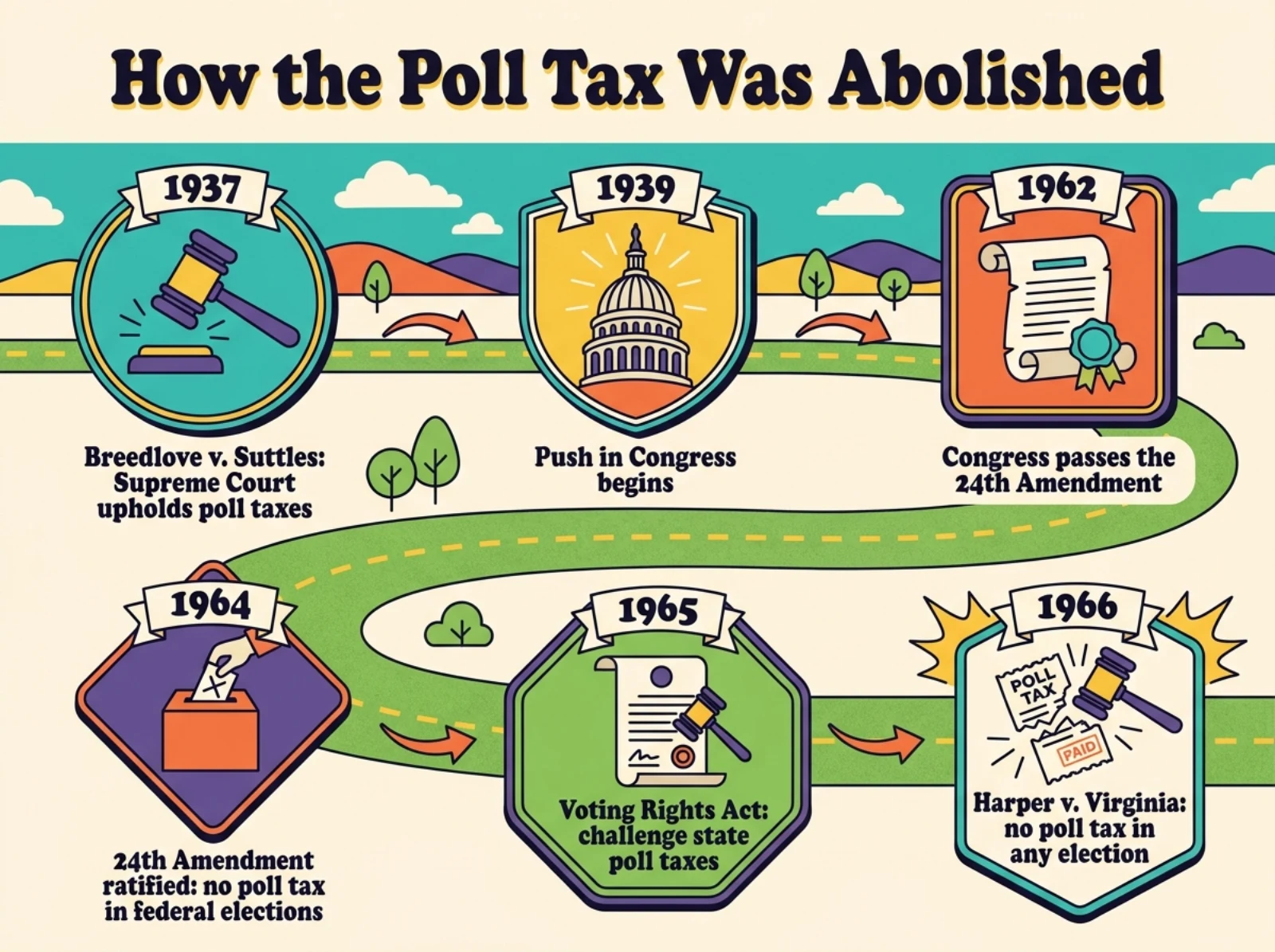
Ending it took about three decades and two routes: a constitutional amendment for federal races, then a Supreme Court case for state elections. According to the Constitution Annotated, the push in Congress to drop the tax as a qualification for federal elections began in 1939. Congress finally sent an amendment to the states in 1962, at the height of the civil rights movement.
| Year | What happened |
|---|---|
| 1937 | Breedlove v. Suttles upholds Georgia’s poll tax. |
| 1939 | The effort in Congress to ban poll taxes in federal elections begins. |
| Aug. 27, 1962 | Congress passes the Twenty-fourth Amendment. |
| Jan. 23, 1964 | The amendment is ratified. Five states still use poll taxes: Alabama, Arkansas, Mississippi, Texas and Virginia. |
| 1965 | The Voting Rights Act directs the Attorney General to challenge poll taxes in state and local elections. |
| Mar. 24, 1966 | Harper v. Virginia Board of Elections ends poll taxes in all elections. |
The Twenty-fourth Amendment (1964)
The text of the 24th Amendment at the National Archives is short. The right to vote in any primary or other election for President, Vice President, presidential electors, Senator or Representative “shall not be denied or abridged by the United States or any State by reason of failure to pay any poll tax or other tax.” Congress passed it on August 27, 1962, and the states ratified it on January 23, 1964. Mississippi was the only Southern state that voted to reject it. Amendments need two-thirds of both chambers before the states weigh in, a process covered in how Congress works.
The catch: this change to the United States Constitution covered federal elections only. Virginia kept its tax for state races and tried to keep federal voters paying, too, by offering a residence certificate as the only alternative. The Court struck that down in Harman v. Forssenius (1965).
Harper v. Virginia Board of Elections (1966)
Combined with a similar suit by Evelyn Thomas Butts, Harper’s case was argued in January 1966 and decided 6-3 on March 24. Writing for the majority, Justice William O. Douglas said that “voter qualifications have no relation to wealth.” A state that makes paying a fee a voting standard therefore violates the Equal Protection Clause of the Fourteenth Amendment. The ruling overruled Breedlove on that point. For how a dispute like this reaches the justices, see how the Supreme Court works.
The dissenters did not defend disenfranchisement. Justice Hugo Black argued that changing the Constitution’s meaning was a job for amendments, not judges. Justice John Marshall Harlan, joined by Justice Potter Stewart, said a state could rationally use the tax to raise revenue and to favor voters with a stake in public affairs.
Is anything a poll tax today?
No state charges a fee to vote. Courts do allow incidental costs, though, such as the time and paperwork of getting an ID or the stamp on a mail ballot. Where those costs end and a modern poll tax begins is still argued.
- Voter ID laws. Critics say ID requirements work like a poll tax when the underlying documents, such as a birth certificate, cost money or time. Supporters say a free ID card removes the fee and that ID rules protect confidence in results. In Crawford v. Marion County Election Board (2008), the Supreme Court upheld Indiana’s photo ID law 6-3, noting that the state issued ID cards free of charge.
- Fines and fees after a felony. After Florida voters restored voting rights to most people with felony convictions in 2018, the legislature required them to pay court fines and fees first. Opponents called that a poll tax. Florida argued that paying a sentence in full is part of the sentence. In 2020, the full Eleventh Circuit sided with Florida 6-4, holding that the rule is not a poll tax under the Twenty-fourth Amendment.
Both sides in these fights cite Harper. They disagree about whether a cost tied to something other than voting counts.
Poll tax FAQ
When was the poll tax abolished?
In two steps: the Twenty-fourth Amendment banned it in federal elections in 1964, and Harper v. Virginia Board of Elections banned it in state and local elections in 1966.
How much was the poll tax?
Usually a dollar or two a year. Virginia’s was capped at $1.50. Where the tax was cumulative, missed years added up.
Did the poll tax affect white voters?
Yes. It applied to everyone, so poor white voters lost access too, though Black citizens carried the heaviest burden because the tax was combined with other barriers aimed at them.
What is the difference between a poll tax and a literacy test?
A poll tax charged money. A literacy test demanded proof of reading or civics knowledge, judged by local officials. The Voting Rights Act of 1965 suspended literacy tests in covered areas, and Congress later banned them nationwide, first temporarily in 1970 and permanently in 1975.
Sources
- National Archives: The Constitution: Amendments 11-27 (Amendment XXIV)
- Harper v. Virginia State Board of Elections, 383 U.S. 663 (1966), Legal Information Institute
- Library of Congress: The Civil Rights Act of 1964: A Long Struggle for Freedom
- National Archives: Laws and Court Cases (African Americans and the Vote)