About The Political Carnival
The Political Carnival explains US politics: how the government works, how elections are won, what the parties stand for and how the news covers it all. Every explainer is nonpartisan, sourced and written so that a high-school student, a teacher and a curious grown-up can all get something out of it. And yes, we still make the occasional joke.
A short history of this domain
From 2009 to 2018 this domain hosted a different blog. Today’s site has no connection to that blog: it does not continue it, does not speak for its former authors and has not republished any of its posts. Since 2026 the domain has had a new owner. Where an old address still receives links, you will find a new, sourced explainer on the same subject, or you are sent to the closest topic.
What we do now
- Explain, don’t campaign. We describe each side in terms its own supporters would recognize.
- Answer first. Every explainer opens with the short answer, then the details.
- Show our sources. Every factual claim links to a primary source: Congress.gov, the Census Bureau, the FEC, court records, polling data.
- Keep the carnival. Humor is aimed at the system, never at voters.
Who writes here
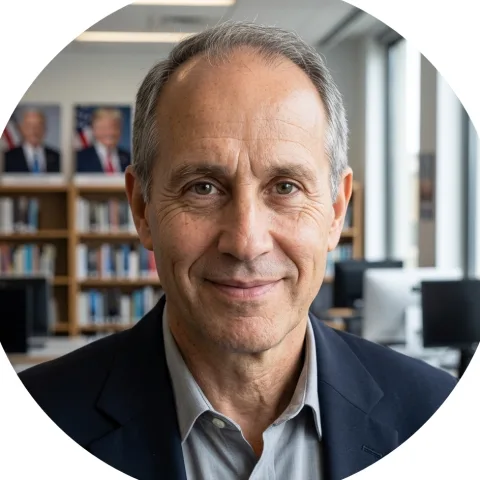
William Rosendahl was born in Landshut, Bavaria, in 1959 and grew up as the eldest of three children in a family where dinner-table conversation rarely strayed from world affairs. His father, a high-school teacher of history and social studies, took him along to town meetings and campaign events while he was still a teenager.
He went on to study political science and modern history at Ludwig Maximilian University in Munich. A semester abroad in Washington, D.C. sparked his interest in transatlantic relations and in how differently political cultures work. He wrote his master’s thesis on the role of regional identity in European integration, a subject that has stayed with him as a committed Bavarian and an equally committed European.
After university he trained as a reporter at a regional newspaper in Lower Bavaria and covered local and state politics for several years. He experienced the fall of the Berlin Wall in 1989 as a young reporter in the local newsroom, a moment he still describes as what turned his eye beyond Bavaria. In the early 2000s he went freelance and turned increasingly to international affairs. For more than two decades he has written about elections, shifts in power and conflicts around the globe, from the European Union and the United States to Southeast Asia and Latin America. He is best known for explaining complex geopolitical connections clearly without oversimplifying them.
Rosendahl sees himself not as a partisan but as a critical observer. He is less interested in the day’s headline than in the long-term developments behind it. For his research he travels regularly and talks with legislators, academics and, above all, ordinary citizens, whose perspective he often finds more revealing than any press conference.
Today he lives with his wife Claudia in an old farmhouse near Rosenheim; the couple have two grown children. When he is not at his desk, you will find him hiking in the Chiemgau Alps, in his large library of political biographies, or at the regulars’ table of the village inn, where, by his own account, he learns more about politics than on many a talk show.
Spotted an error? Please tell us on the contact page. Corrections are made openly and dated on the page.