The short answer
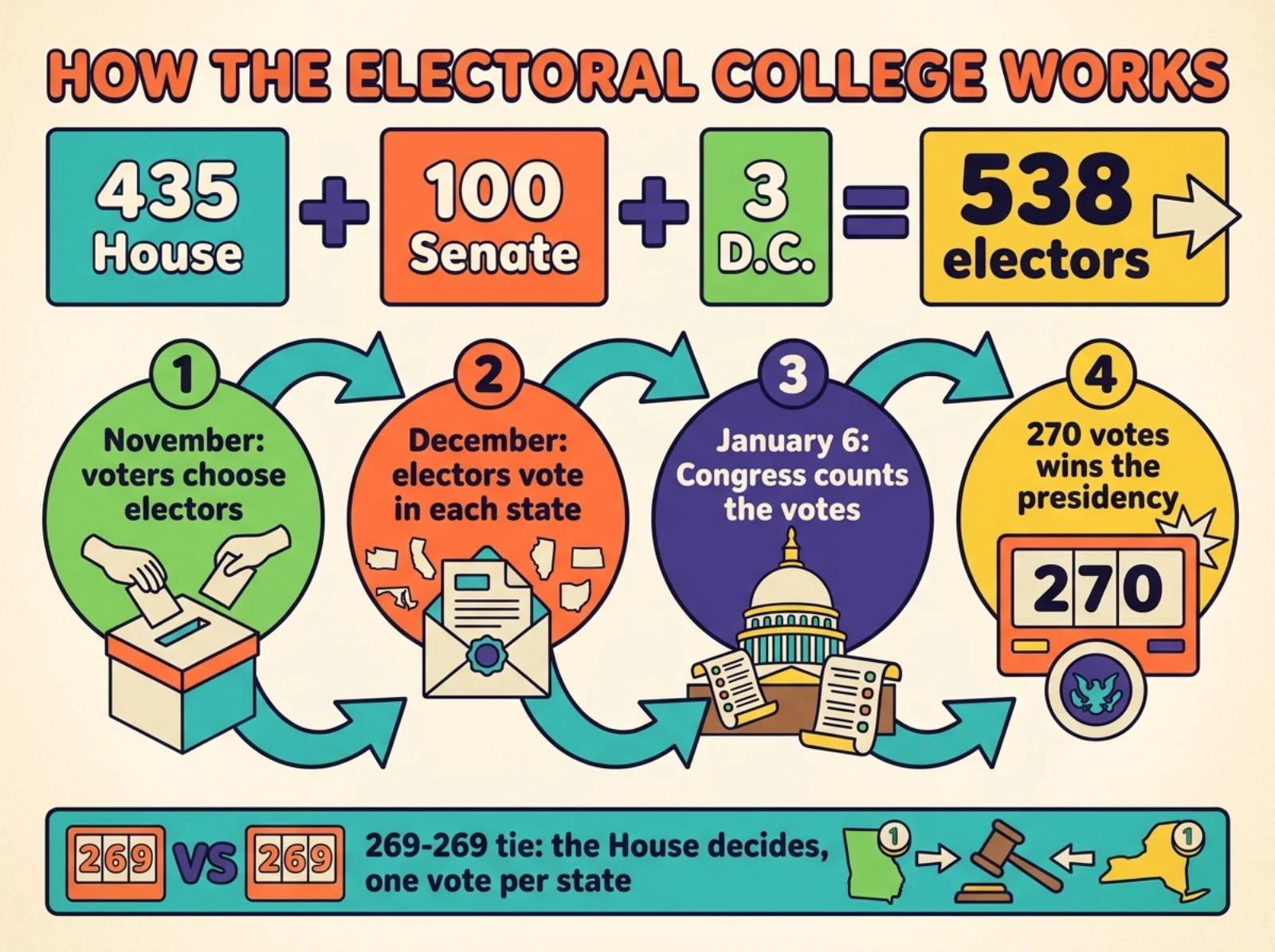
Americans vote for a slate of electors, not directly for president. Each state gets as many electors as it has members of Congress, D.C. gets 3, and the total is 538, so a candidate needs 270 electoral votes to win. If nobody reaches 270, the House of Representatives picks the president, with one vote per state delegation.

Twelve states are enough. Win the 12 states with the most electoral votes, even by a single ballot each, and you collect 281 electoral votes. That is enough to become president while losing the other 38 states and Washington, D.C. by any margin you like.
Nobody has ever won that way, but the math is a good first answer to how does the Electoral College work. In the United States, voters don’t elect a president directly. They elect electors, state by state, and the electors pick the president. Below is the whole process, from your November ballot to the count in Congress, with rules current as of October 2026.
What is the Electoral College, in simple terms?
The Electoral College is a process, not a place. There is no campus and no tuition, although the alumni do get a certificate. The process has three parts:
- Each state chooses its electors through the general election in November.
- The electors meet in their own states in December and cast separate votes for President and Vice President.
- Congress counts those electoral votes in a joint session on January 6.
The Founding Fathers settled on this design in 1787 as a compromise between delegates who wanted Congress to choose the president and those who wanted a national popular vote. Article II of the Constitution sets the framework; the 12th Amendment (1804) changed how electors vote.
How many electors are there, and where do the 538 come from?
There are 538 electors. Each state gets one for every member it has in the House of Representatives plus two for its senators: 435 House seats, plus 100 Senate seats, plus 3 electors for the District of Columbia under the 23rd Amendment.
Because House seats follow population, the census reshuffles the map every ten years. The numbers from the 2020 Census apply to the 2024 and 2028 presidential elections. The National Archives publishes the electoral vote allocation for every state. The biggest and smallest look like this:
| State | Electoral votes (2024 and 2028) |
|---|---|
| California | 54 |
| Texas | 40 |
| Florida | 30 |
| New York | 28 |
| Illinois, Pennsylvania | 19 each |
| Alaska, Delaware, North Dakota, South Dakota, Vermont, Wyoming, D.C. | 3 each |
No state can drop below three, since every state has two senators and at least one House member.
Who are the electors, and how are they chosen?
Electors are usually loyal party members. Each political party in a state nominates a slate of potential electors before the general election, under rules that vary by state. The Constitution bars members of Congress and other federal officeholders from serving.
When you vote for a presidential candidate, you are really voting for that candidate’s slate. After the presidential election, the governor signs a Certificate of Ascertainment that lists the winning electors and the vote totals, and sends a copy to the National Archives.
Why does 270 win the election?
Because 270 is a majority of the electoral votes. Half of 538 is 269, so the first candidate past that line wins the presidency.
In 48 states and D.C., the winner of the state’s popular vote gets all of its electors. This winner-take-all rule is why campaigns spend most of their time and money in a few swing states and treat safe states as a place to change planes.
Why do Maine and Nebraska split their electoral votes?
Maine and Nebraska use the district method. The statewide winner gets two electoral votes, one for each senator. Each congressional district then awards one electoral vote to whoever won that district. Maine has two districts and Nebraska has three, and both states have split their votes in recent elections. Any other state could switch by changing its own law, because the Constitution lets each legislature decide how its electors are appointed.
Do electors have to vote for the candidate who won their state?
Mostly, yes. No federal law requires it, but 32 states and D.C. had laws as of 2020 requiring electors to vote for their party’s nominee. An elector who breaks that pledge is called a faithless elector.
In 2016, seven electors cast faithless votes, the most in a century. Three of them came from Washington state, which fined them $1,000 each. The case reached the Supreme Court, and in Chiafalo v. Washington (2020) the justices ruled, without a dissent, that a state may enforce an elector’s pledge. Faithless electors have never changed who won: since the founding, they have cast about 180 votes out of more than 23,000.
What happens if there is a 269-269 tie?
A tie, or any result where no candidate reaches 270, sends the election to Congress. This is called a contingent election, and the 12th Amendment sets the rules:
- The newly elected House of Representatives chooses the president from the top three candidates.
- Each state delegation casts one vote, no matter how many members it has. Wyoming’s single representative counts as much as California’s 52.
- A candidate needs 26 state delegations to win, and the House keeps voting until someone gets there.
- The Senate separately chooses the vice president from the top two, with 51 votes needed.
- If the House has not chosen a president by Inauguration Day, the vice president-elect acts as president until it does.

The House has picked the president twice, after the elections of 1800 and 1824. The 1800 race ended in a tie between Thomas Jefferson and his own running mate, Aaron Burr, which is exactly the kind of mess the 12th Amendment was written to prevent.
Can a candidate win the popular vote and lose the election?
Yes. A candidate can rack up huge margins in some states, lose narrowly in others, and finish with more votes nationally but fewer electoral votes.
| Election | Won the national popular vote | Became president | What happened |
|---|---|---|---|
| 1824 | Andrew Jackson | John Quincy Adams | No electoral majority; the House chose Adams |
| 1876 | Samuel Tilden | Rutherford B. Hayes | Disputed electoral votes settled by a commission |
| 1888 | Grover Cleveland | Benjamin Harrison | Harrison won the Electoral College |
| 2000 | Al Gore | George W. Bush | Bush won the Electoral College after the disputed Florida count |
| 2016 | Hillary Clinton | Donald Trump | Trump won the Electoral College |
The National Archives counts four elections where the Electoral College winner lost the popular vote: 1876, 1888, 2000 and 2016. In 1824 nobody won a majority of electoral votes, so the House decided. Supporters of the system say it makes candidates build support across many states; critics say every vote for president should count equally. Abolishing the Electoral College would take a constitutional amendment, while each state can change how it awards its own electors.
What happens after the electors vote?
The meeting of the electors takes place on the first Tuesday after the second Wednesday in December. Each state’s electors record their votes on a Certificate of Vote and send it to Congress and the National Archives. On January 6, Congress counts the electoral votes in a joint session, with the vice president presiding as President of the Senate. The new president is sworn in on January 20.
After the 2020 election, Congress rewrote the counting rules in the Electoral Count Reform Act of 2022, updating a law from 1887:
- The vice president’s role in the count is “solely ministerial.” The vice president has no power to accept or reject electors.
- An objection to a state’s electoral votes needs the support of at least one-fifth of the House and one-fifth of the Senate. Before, one member of each chamber was enough.
- Each state’s governor (unless state law names another official) submits the single certificate Congress will accept.
- Disputes a presidential candidate brings over a state’s certificate get fast-tracked review by a three-judge federal court, with direct appeal to the Supreme Court.
Our guide to how Congress works explains the two chambers, and primary elections covers how candidates reach the November ballot in the first place.
Which Electoral College numbers should you remember?
- 538 electors in total
- 270 electoral votes needed to win
- 3 electors minimum per state, and 3 for D.C.
- 2 states, Maine and Nebraska, that split their votes by district
- 26 state delegations needed to win a contingent election in the House
- 5 elections in which the popular vote winner did not become president
Sources
- National Archives: Distribution of Electoral Votes (2024 and 2028)
- National Archives: Electoral College Frequently Asked Questions
- National Archives: The Constitution of the United States, A Transcription (Article II, 12th and 23rd Amendments)
- Supreme Court of the United States: Chiafalo v. Washington, 591 U.S. ___ (2020)