 By
The short answer
Political ideologies are sets of ideas about how society should be run. The easiest way to compare them is a two-axis map: one axis for the economy (more government role vs. freer markets) and one for social life (personal freedom vs. tradition and order). Liberalism, progressivism, conservatism, libertarianism, socialism, populism, nationalism and centrism each land in a different spot.
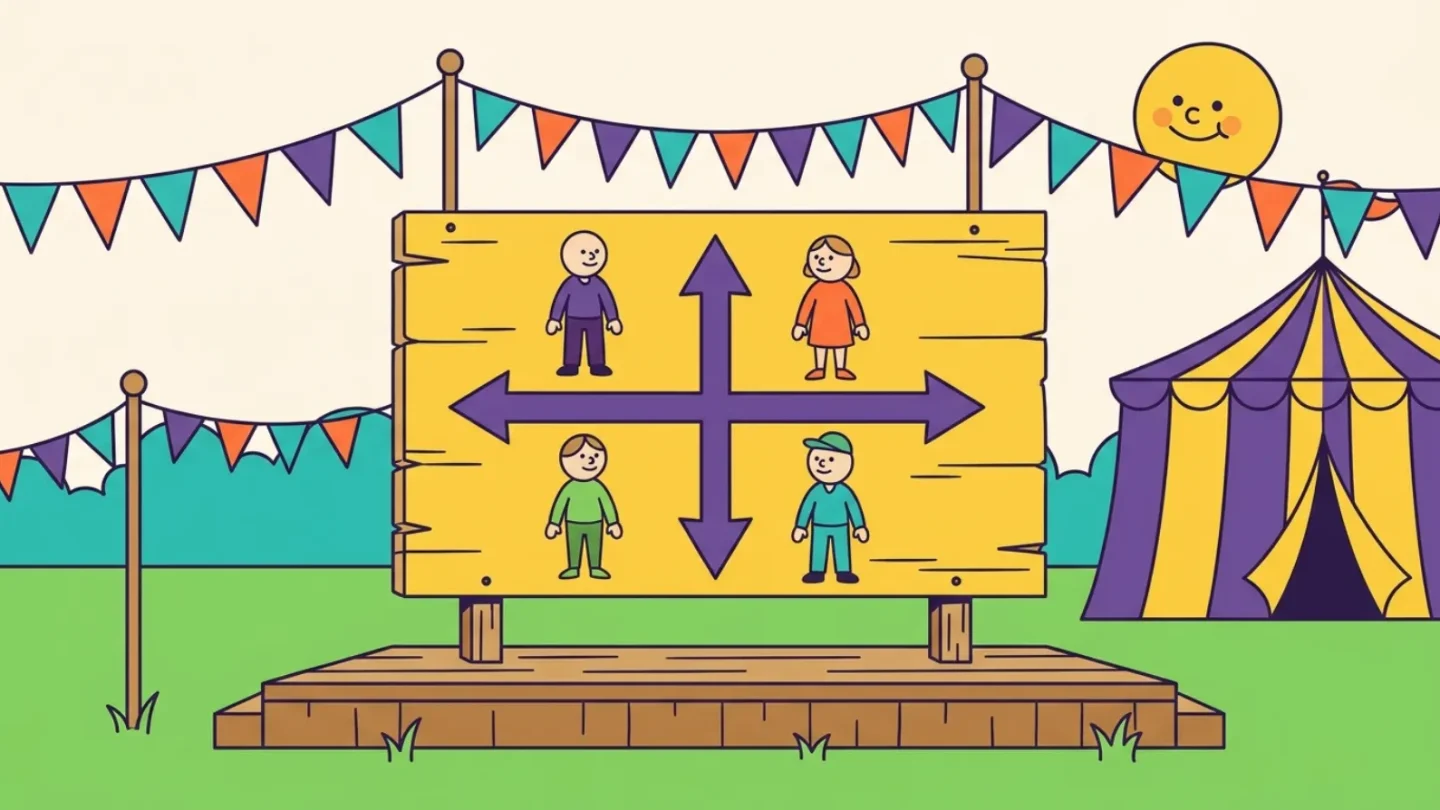
Ask a room of voters to line up from “far left” to “far right” and watch. A small-government voter who also wants marijuana legalized has no idea where to stand. Neither does a union member who goes to church every Sunday and wants tighter borders. The line is too short for the people on it.
A political ideology is a set of ideas about how society should be organized: who holds power, what the state may do and what it must leave alone. Political ideologies are easier to compare on a map with two directions rather than one. This guide places all the major ones on such a map and describes each ideology in terms its own supporters would accept.
Why does a single left-right line fall short?
The terms left and right date from the French Revolution. In 1789, defenders of the king and the old order sat on the right side of the assembly hall, and those pushing for change sat on the left. The seating chart has outlived the French monarchy by more than two centuries, which tells you how hard it is to retire a convenient label.
The trouble is that one line mixes two separate questions:
- How much should the state manage the economy, through taxes, regulation, welfare and ownership?
- How much should the state or tradition shape personal and social life, such as religion, family, speech, drugs and immigration?
A voter can answer these two questions in very different ways. That is why many political scientists prefer to draw the political spectrum with two dimensions, not one.
The two-axis map of politics: economy and society
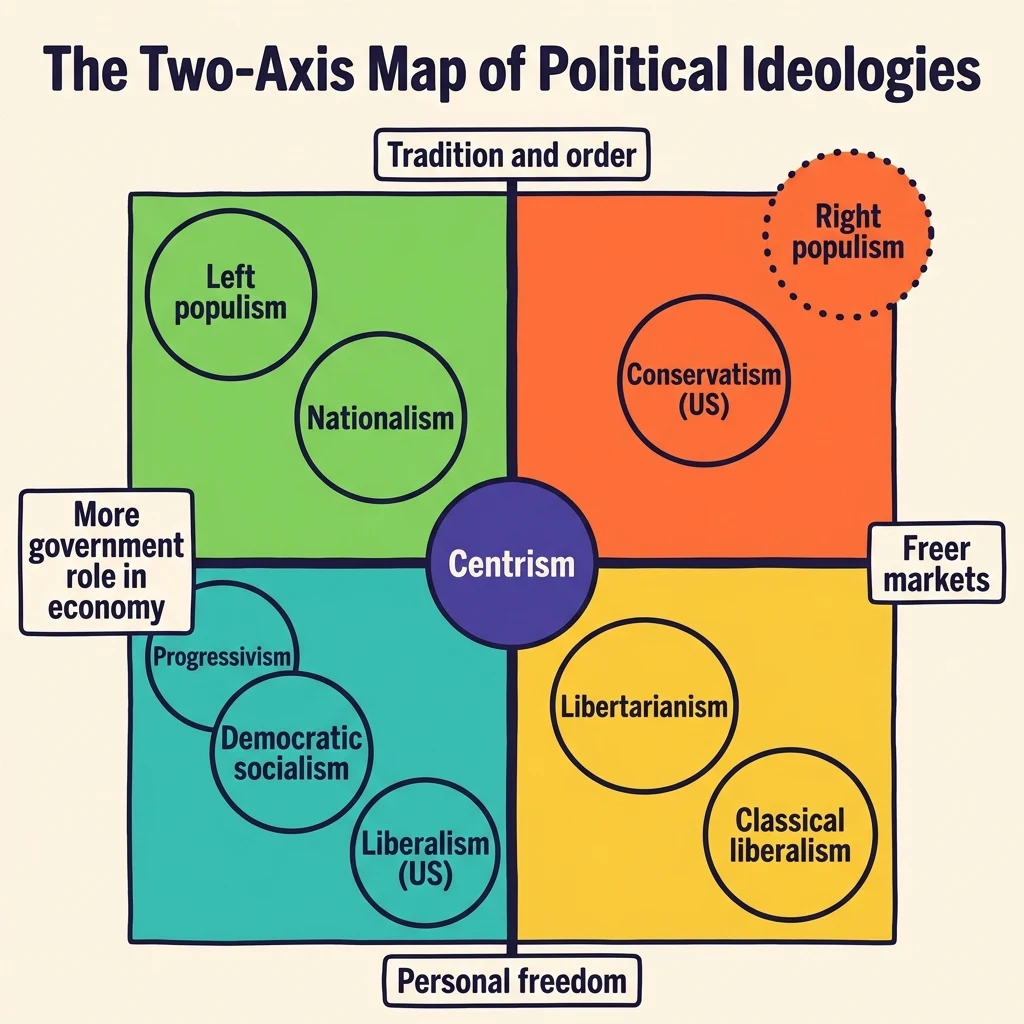
Picture a cross. The horizontal axis is economic. At the left end are those who advocate for more government action to reduce inequality. At the right end are those who want freer markets, lower taxes and lighter regulation. The vertical axis is social and personal life. At the top sits more order, tradition or state authority. At the bottom sits more individual freedom.
Two well-known tools use versions of this idea. The Nolan Chart, created by the libertarian David Nolan, measures economic freedom against personal freedom. The Political Compass, a popular online quiz, plots users on a similar grid.
| Corner of the map | Economy | Social life | Ideologies often found here |
|---|---|---|---|
| Bottom left | Larger government role | More personal freedom | Progressivism, democratic socialism, modern American liberalism |
| Top right | Freer markets | More tradition and order | Mainstream American conservatism |
| Bottom right | Freer markets | More personal freedom | Libertarianism, classical liberalism |
| Top left | Larger government role | More tradition and order | Some left populism, some nationalism |
Centrism sits near the middle of the political spectrum. Populism and nationalism move around, because their focus is less on tax rates and more on who the political system serves.
The major political ideologies, placed on the map
Liberalism
Liberals start from liberty and equality before the law. The Stanford Encyclopedia of Philosophy describes liberalism as a philosophy built on the idea that political authority must be justified to the people who live under it. Classical liberalism ties individual freedom to private property and markets. The “new” or social liberalism of the 20th century holds that a safety net and rules for markets make freedom real for those who would otherwise lack the means to use it. In the United States, “liberal” usually means this second kind, which is why liberal and conservative Americans argue so much about the size of government.
Progressivism
Progressives treat liberalism as a starting point but want to go further and faster. In their own words, they want an economy and a democracy that work for everyone, along with stronger action on climate change, health care access, civil rights and equality. On the map, progressives sit further left on economics than most liberals and well toward personal freedom.
Conservatism
Conservatives value what time has tested. The thinker Edmund Burke argued that a state without some means of change is without the means of its own conservation, so conservatism favors careful, gradual reform built on institutions such as family, faith, local community and the Constitution. American conservatism, like other conservative traditions, values order, but it also carries a strong commitment to free markets, limited government and lower taxes. Our guide to liberal vs. conservative views compares the two sides in detail.
Libertarianism
Libertarians want the smallest government that can protect individual rights. They see voluntary exchange and individual choice as the best guides for the economy and for private life. That puts them right on economics and at the bottom of the social axis: low taxes, few regulations, and the state out of the bedroom, the medicine cabinet and the wallet.
Socialism and democratic socialism
Socialists believe the economy should serve the many, with major industries or resources owned or controlled collectively. Democratic socialists pursue these goals through elections and civil liberties rather than a one-party state. In American usage, many self-described democratic socialists focus on policies such as universal health care, stronger unions and higher taxes on the wealthy. That puts them far left on economics.
Populism, left and right
Populism describes politics as a contest between ordinary people and a corrupt or out-of-touch elite. Supporters say it gives a voice to citizens the system ignores. Left populists aim at banks, corporations and concentrated wealth. Right populists aim at cultural, political and media elites, and they often stress border control and national sovereignty. Populism is more a style than a program, so it can appear in almost any corner.
Nationalism
Nationalists put the interests, identity and independence of their own nation first. Supporters say a shared identity holds a diverse country together and that a government owes its first duty to its own citizens. It is an ideology that often pairs with right-leaning views on immigration and trade, but left-wing nationalist movements exist as well.
Centrism
Centrists, or moderates, pick and choose. They see merit on both sides and prefer compromise to any rigid ideology. A centrist may back a balanced budget and also support background checks for gun sales.
US vs. European labels
Labels change when they cross the Atlantic. In much of Europe, “liberal” still means classical liberal: free markets, civil liberties and a limited state. Germany’s Free Democratic Party is liberal in that sense, and on economics it often sits right of center. Conservative parties in Europe often accept a larger welfare state than American conservatives would. Social democratic parties have governed many European countries, while “socialist” remains a fighting word in American politics.
Party labels and ideology labels differ too. Our guide to Democrat vs. Republican shows how each major party holds a coalition of several ideologies at once.
Where do Americans actually land?
Few voters fit neatly in one box. The Pew Research Center’s political typology, published in June 2026, sorted Americans into nine groups based on 30 questions about political values. Pew found that most Americans fall into a large, “politically messy center.” These groups are not tidy partisan teams. About 15% of Republicans and Republican leaners hold values that place them left of center overall, and a similar share of Democrats sit right of center. The one group in the middle, the Tuned-Out Middle (9% of adults), is politically divided and pays little attention to politics.
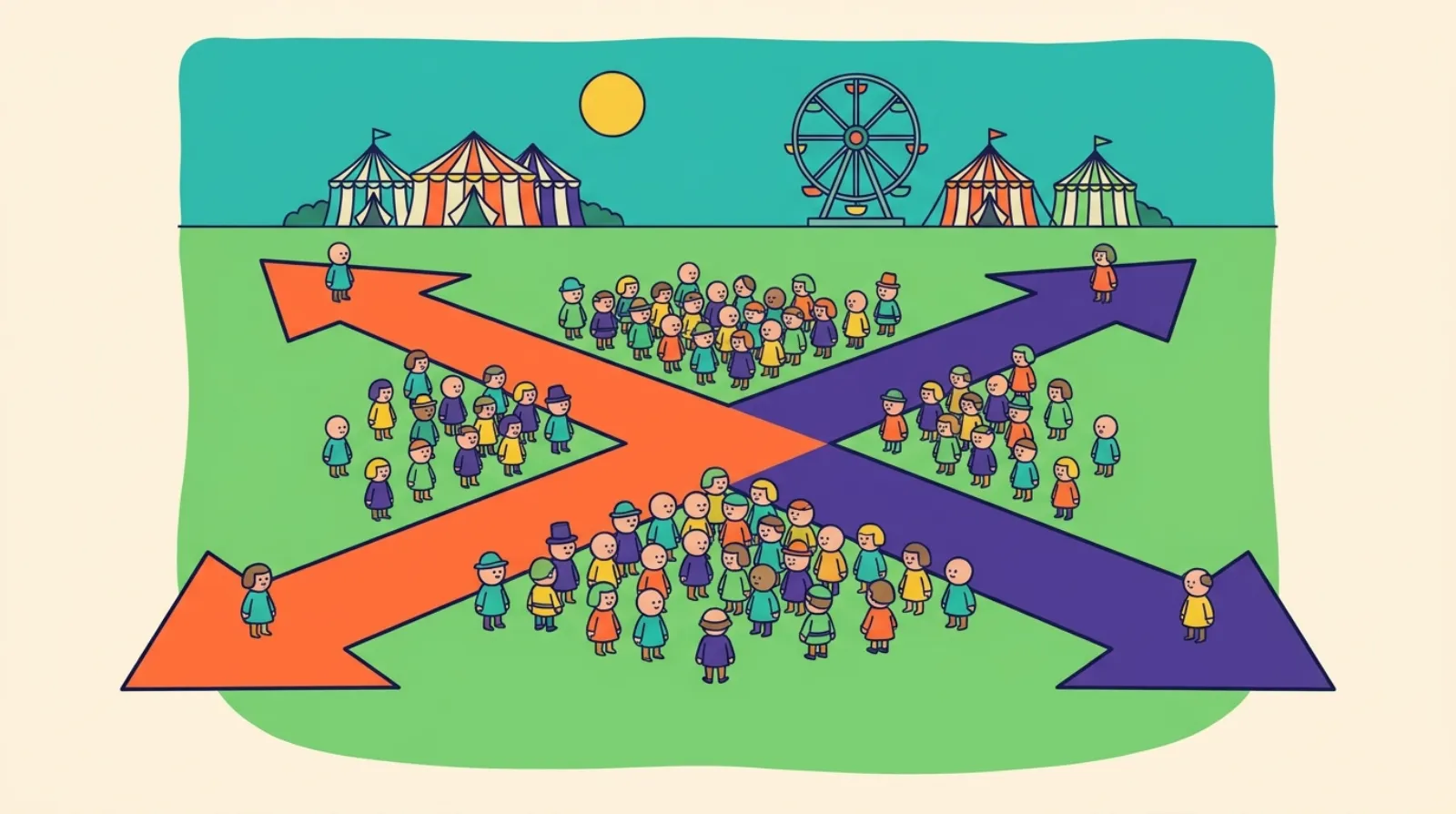
Voters who feel left out by both parties often look at third parties, from the Libertarians to the Greens.
5 questions to place yourself on the map
Use this checklist to find your rough spot. There are no right answers, and plenty of us end up somewhere in between.
- Taxes and spending: Should government collect more to fund programs like health care and education, or collect less and let you keep what you earn?
- Markets: When a market produces a bad outcome, is your first instinct to regulate it or to let competition fix it?
- Personal choices: Should the state stay out of choices about drugs, marriage and speech, or protect shared moral standards?
- Change: Do you trust bold reform, or slow change that keeps proven institutions?
- Power: Is the main divide between rich and poor, between ordinary citizens and elites, or between competing ideas of freedom?
Questions 1 and 2 set your economic position, 3 and 4 your social one. Question 5 tells you whether populism is part of your mix.