 By
The short answer
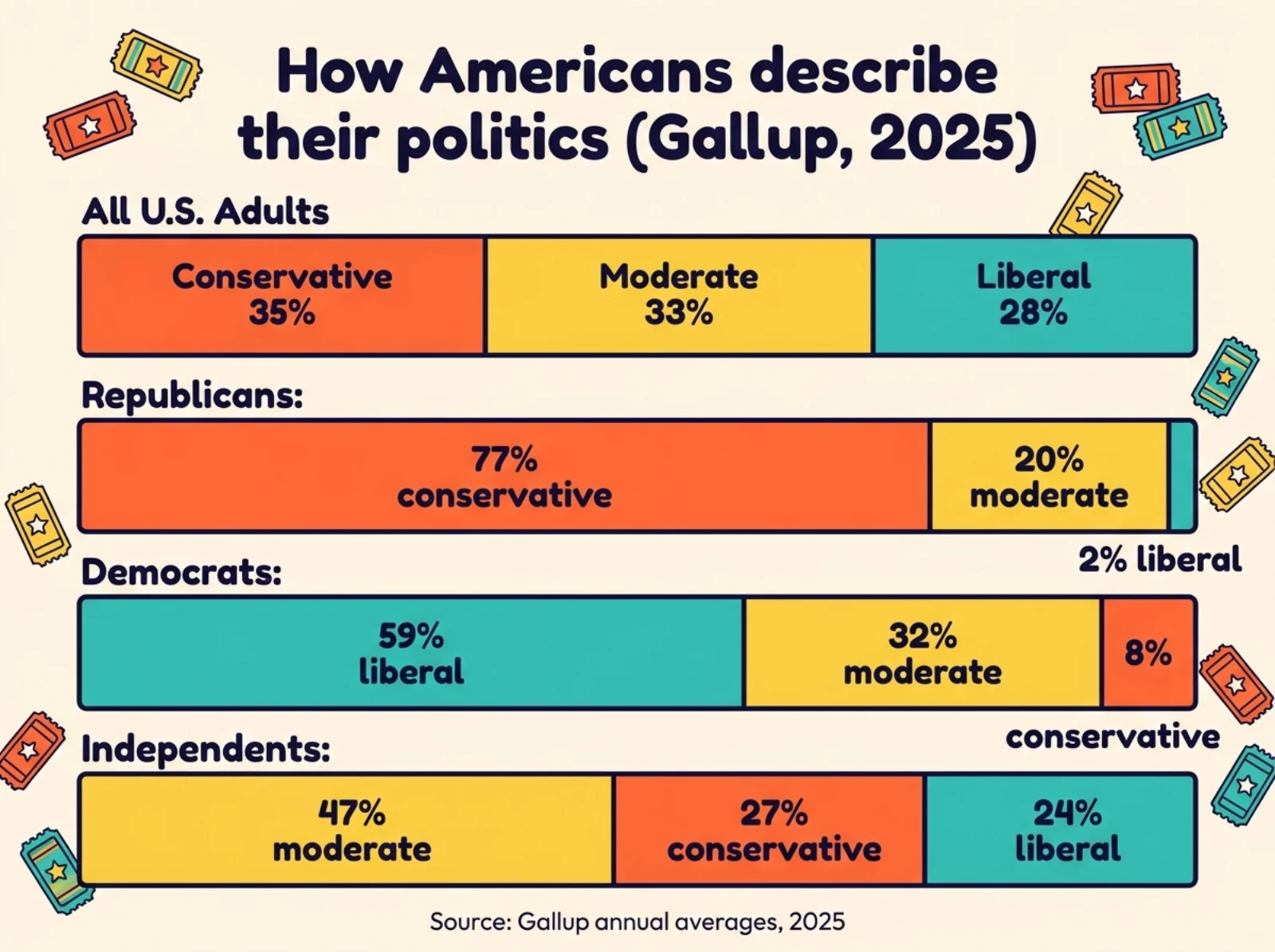
In the US, liberals generally favor an active government that reduces inequality and protects individual rights, and they welcome social change. Conservatives generally favor limited government, lower taxes and free markets, and they value tradition and established institutions. In Gallup's 2025 data, 35% of Americans called themselves conservative, 33% moderate and 28% liberal.

Most of what Americans “know” about the liberal vs conservative divide comes from the other side’s campaign ads, which is a bit like learning about cats from a dog. Both labels describe real political philosophies with long histories in American politics, and both are bigger and messier than the caricatures.
In the United States, a liberal generally believes that government should play an active role in reducing inequality and protecting individual rights, and is comfortable with social change. A conservative generally believes that society works best with a smaller government, lower taxes and free markets, and puts weight on tradition, family, faith and institutions that have proven themselves over time. Everything below tests that definition against the myths and the data, as of October 2026.
Liberal vs conservative at a glance
Before the myths, here is how liberals and conservatives tend to describe their own core beliefs. These are broad tendencies, not a membership card.
| Topic | Liberal view (typical) | Conservative view (typical) |
|---|---|---|
| Role of government | An active government that fixes problems markets miss | A limited government that leaves room for people, families and communities |
| Economy | Free market with strong rules, unions and a safety net | Free market with low taxes and light regulation |
| Social change | Welcomes change that widens individual rights | Prefers gradual change that keeps proven traditions |
| Health care | Government should guarantee coverage for those who lack it | The private sector and competition should drive coverage and cost |
| The Constitution | Principles applied to new conditions | Text read as its authors understood it |
| Supreme Court | Judges protect rights as society changes | Judges apply the law as written and leave policy to voters |
| Core value | Equality and fairness | Liberty and personal responsibility |
Myth 1: Liberals want the government to run everything
This is a favorite line on the right, but liberals describe their own position differently. American liberals overwhelmingly accept a market economy and private property. What they believe is that the state should step in where markets fall short for those who have the least.
In practice, that means support for programs like Social Security and Medicare, environmental rules, consumer protection, public schools and civil rights laws. The liberal argument is that these programs make individual freedom real for people who would otherwise lack the money or power to use it. Liberals also tend to want government out of other areas, such as decisions about marriage, reproduction or personal speech, so “big government” fits some liberal ideas and not others.
Myth 2: Conservatives just want to stop all change
A favorite line on the left runs: liberals want to move forward, conservatives want to stand still. Conservatives answer that they push for plenty of change in politics. Tax cuts, deregulation, school choice, stricter border enforcement and a narrower reading of federal power are all changes conservatives have fought for.
The conservative disposition is about the pace and the source of change. Since the British thinker Edmund Burke, modern conservatism has argued that customs and institutions such as the family, churches and local communities hold knowledge that no single generation of planners has. So conservatives prefer reform that is gradual, tested and close to home over sweeping plans from Washington.
Myth 3: Liberal means Democrat, and conservative means Republican
Conservative and liberal labels overlap a lot with party labels. They are still not the same thing, and Gallup’s numbers show it. In 2025, according to Gallup’s annual party and ideology data, the parties looked like this:
- Republicans: 77% conservative, 20% moderate, 2% liberal.
- Democrats: 59% liberal, 32% moderate, 8% conservative.
- Independents: 47% moderate, 27% conservative, 24% liberal.
So roughly four in ten Democrats do not call themselves liberal, and more than one in five Republicans do not call themselves conservative. The parties have sorted over time: only 25% of Democrats called themselves liberal in 1994, and 58% of Republicans said they were conservative. For how the Democratic and the Republican Party themselves differ, see our guide to Democrat vs. Republican.
Myth 4: Conservatives are one united bloc
From the outside, the right can look like a single team. Pew Research Center’s political typology, released in June 2026 and based on a survey of 10,357 adults in November 2025, found four distinct groups on the right side of the spectrum:
- No Apologies Right (9% of adults): the most conservative on most issues.
- Faith First Conservatives (12%): focused most on religion and traditional morality.
- Unconventional Right (12%): younger, less engaged, somewhat more moderate on abortion and the safety net.
- Pragmatic and Polite Right (11%): the oldest group, conservative on economics, more moderate on race and immigration, and only modestly Republican.
These groups disagree on real questions, including how much they back the current Republican leadership. Approval of President Trump ranged from 90% in the No Apologies Right to 36% in the Pragmatic and Polite Right. “Conservative” covers a religious traditionalist, a free-market libertarian and a populist worried about trade, and they do not always agree.
Myth 5: Liberals are one united bloc
The same is true on the left. Pew identified four groups there as well: Leftward Progressives (7%), Loyal Liberals (11%), the Left-Out Left (12%) and the Order and Opportunity Left (18%), which is the largest of all nine groups.
The differences are not small. Leftward Progressives are the youngest and most liberal group, yet only 61% view the Democratic Party favorably, compared with 77% of Loyal Liberals. The Order and Opportunity Left is economically liberal but more concerned about crime and more supportive of immigration restrictions than other majority-Democratic groups, and a quarter of it leans Republican. Pew also found that about 15% of Republicans and Republican leaners hold values that place them left of center, with a similar share of Democrats right of center. Nobody’s coalition is as tidy as the cable news graphics suggest.
Myth 6: “Liberal” means the same thing everywhere
Say “liberal” in Berlin or Sydney and you may get a very different picture, because liberalism means different things around the world. In much of Europe, liberalism still refers to classical liberalism: free markets, lower taxes, civil liberties and a limited state. Germany’s Free Democratic Party (FDP) is the textbook liberal party, and on economics it usually sits right of center. In Australia, the Liberal Party is the main center-right party.
American usage shifted in the 20th century, when “liberal” came to describe the New Deal tradition of active government. In a twist that confuses every exchange student, many American conservatives describe their economic views in terms a European would call liberal. When reading foreign news, check which liberal is meant. Our overview of political ideologies traces the older meanings.
Myth 7: Conservatives are a clear majority of Americans
Conservatives have been the largest ideological group in the United States in Gallup’s annual data for years, but they are not a majority, and the lead is shrinking. In 2025, 35% of U.S. adults called themselves conservative, 33% moderate and 28% liberal. Gallup says the seven-point conservative advantage is the smallest it has measured in annual averages going back to 1992.
The long-run shift comes mostly from the left side: liberal identification rose from 17% in 1992, moderate identification fell from 43%, and conservative identification stayed fairly steady. A third of the country still picks “moderate,” so the loudest voices on either side are not a good guide to the typical American.
Where people really stand: key takeaways
- Liberals stress equality and an active government; conservatives stress liberty, tradition and a limited government.
- Party and ideology overlap without matching: 8% of Democrats call themselves conservative, and 20% of Republicans call themselves moderate.
- Pew counts four distinct groups on the left and four on the right.
- One in three Americans calls themselves moderate.
- A European “liberal” often sounds like an American conservative on economics.
Want to see where the labels go from here? Our guide to third parties covers the Americans who reject both camps.