The short answer
Under the 22nd Amendment, ratified in 1951, no one can be elected president more than twice. A vice president who takes over with two years or less left in a term can still be elected twice, so the maximum is just under 10 years. Changing the rule takes a constitutional amendment: two-thirds of Congress plus 38 states.

Ask a classroom how long a president can stay in office and the answer comes back fast: two terms, eight years, it’s in the Constitution. That’s mostly right, with some fine print. Until 1951 the two-term rule was only a habit, the real ceiling is closer to a decade, and one part of the 22nd Amendment has never been tested.
The topic returns every election cycle, and so do the same misconceptions. Here are five, checked against the amendment’s text and the official Constitution Annotated.
Myth 1: “The Constitution always limited presidents to two terms”
Not true. The original Constitution of 1787 set a four-year term and no limit on reelection.
The two-term limit started as a tradition. George Washington retired after two terms and announced it in his Farewell Address in September 1796. Thomas Jefferson did the same in 1808 and warned that unlimited reelection could turn the office into a life tenure. After Jefferson, the two-term tradition held, although a few presidents tested it or chose to seek a third term:
- Ulysses S. Grant sought a third nomination at the 1880 Republican convention and lost it to James Garfield.
- Theodore Roosevelt ran in 1912 on the Progressive ticket after serving most of William McKinley’s term plus one of his own, and lost.
- Franklin D. Roosevelt won a third term in 1940 and a fourth term in 1944. He died in April 1945, a few months into that fourth term.
After FDR, Congress wrote the custom into law. A 1947 House report cited “a well-defined custom” against more than two terms. Congress passed the 22nd Amendment on March 21, 1947, and the states ratified it on February 27, 1951, according to the National Archives transcript of Amendments 11 through 27.
Section 1 also has a grandfather clause: “this Article shall not apply to any person holding the office of President when this Article was proposed by the Congress.” It also let anyone acting as president during the term it took effect finish that term. That covered the sitting president, Harry Truman, who chose not to run in 1952.
Myth 2: “A president can never serve more than 8 years”
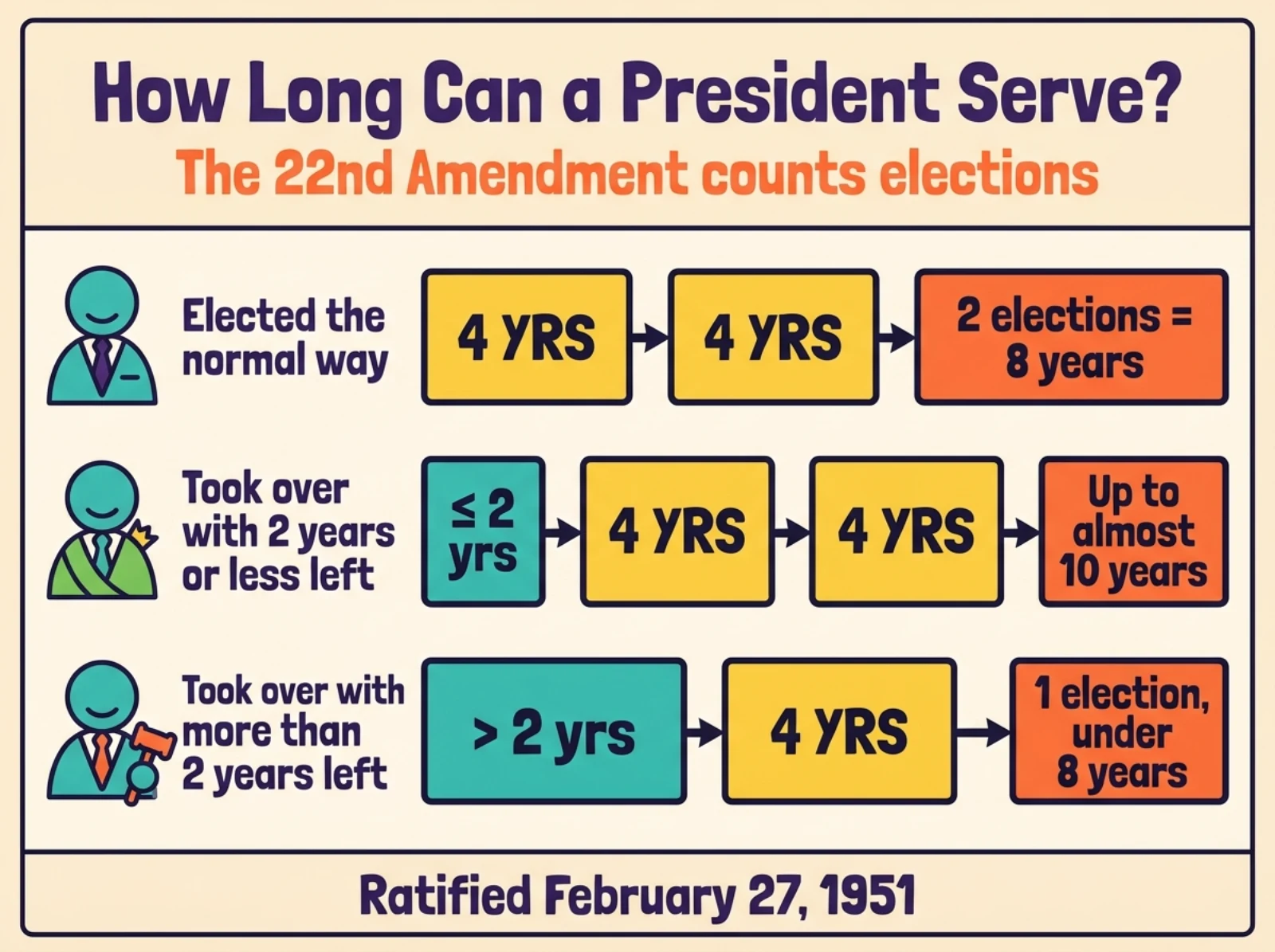
Close, but no. The amendment limits how many times a person may be *elected*, not how long they serve. Section 1 says:
“No person shall be elected to the office of the President more than twice, and no person who has held the office of President, or acted as President, for more than two years of a term to which some other person was elected President shall be elected to the office of the President more than once.”
It depends on how they got the job:
| How they became president | Elections still allowed | Longest possible time in office (years) |
|---|---|---|
| Elected the normal way | Two | 8 |
| Took over (or was acting president) with 2 years or less left | Two full terms | Just under 10 |
| Took over with more than 2 years left | One | Under 8 |
Lyndon B. Johnson is the textbook case. He became president in November 1963 and served about 14 months of John F. Kennedy’s term. Because that was under two years, he was eligible to be elected twice. He won in 1964 and could have run in 1968, but chose not to. Gerald Ford took over in August 1974 with roughly 29 months left in Richard Nixon’s term, so he could only be elected once. He lost in 1976.
Myth 3: “Non-consecutive terms reset the clock”
It doesn’t. The amendment counts elections, and it says nothing about whether they come back to back. Two wins in any order use up the limit.
Grover Cleveland served 1885 to 1889 and 1893 to 1897, before any limit existed. Donald Trump won in 2016, lost in 2020 and won again in 2024. Under the plain text of the 22nd Amendment, that’s two elections, and his current term ends on January 20, 2029.
Myth 4: “A two-term president could just run as vice president”
Nobody knows for sure, because it has never happened and no court has ruled on the question.
The 22nd Amendment bans being *elected* president a third time. It doesn’t ban *serving*, and the Constitution Annotated notes that broader wording (“shall be chosen or serve as President”) was considered in 1947 and rejected. The 12th Amendment adds that “no person constitutionally ineligible to the office of President shall be eligible to that of Vice-President.”
The two main readings:
- The door is closed: A two-term president is “constitutionally ineligible” to be president, so the 12th Amendment bars them from the vice presidency too. Many constitutional scholars read it this way.
- The door is ajar: The person is only barred from being *elected* president, so they aren’t fully ineligible, and they could become president by succession if the top job opened up.
The Constitution Annotated says the 22nd Amendment “has yet to be applied” and lists this as an open question. It also leaves open whether a two-term president could serve as Speaker of the House, next in line after the vice president. A real case would likely end at the Supreme Court (see how the Supreme Court works).
Any such ticket would still need to win the Electoral College, which is a separate hurdle.

Myth 5: “Congress can change term limits by passing a law”
Wrong. Presidential term limits are in the Constitution of the United States, so only a constitutional amendment changes them. A regular bill or an executive order won’t do it. Article V sets the route:
- Two-thirds of the House and two-thirds of the Senate approve a joint resolution. (A convention called by the states is the other route; it has never been used.)
- The proposal goes to the states. The president plays no formal role and has no veto.
- Three-fourths of the states, which today means 38 of 50, ratify it.
That bar is high on purpose. The country has ratified 27 amendments since 1789, and the most recent one, the 27th, took more than two centuries to finish, which makes even a slow committee look speedy.
Proposals do get filed. In January 2025, Representative Andy Ogles (R-Tenn.) introduced H.J.Res. 29, which would allow up to three elections while barring anyone who had already served two consecutive terms. It was referred to the House Judiciary Committee and, as of October 2026, has had no further action. Earlier repeal proposals never reached a floor vote either. Lawmakers themselves have no limits, a debate covered in term limits for Congress.
The third-term debate as of October 2026
President Trump has raised the question of a third term several times since returning to office. In March 2025 he told NBC News there were “methods” for doing it. More recently he has sounded more cautious. Asked again on August 11, 2026, he said: “I’d love to run, but the law is very strong.”
Those who want to loosen the limit usually argue:
- The people, through their votes, should be free to reelect a president they want to keep.
- Prime ministers in parliamentary democracies such as the United Kingdom and Canada face no term limits.
Those who defend the 22nd Amendment as written usually argue:
- Limits guard against one person gathering too much power for too long.
- The rule has been in place since 1951, and changing it for a sitting president would look like changing the rules mid-game.
As of October 2026, no amendment to change the limit has passed either chamber. The 22nd Amendment reads exactly as it did in 1951.
FAQ: presidential term limits
How many terms can a president serve?
A president can be elected twice. Someone who takes over with two years or less left in a predecessor’s term may still be elected to two full terms, for a total of nearly a decade.
Has any president served more than two terms?
Only Franklin D. Roosevelt, who was elected four times (1932, 1936, 1940 and 1944) before the 22nd Amendment existed.
Can the 22nd Amendment be repealed?
Yes, through another constitutional amendment: two-thirds of both chambers of Congress, then ratification by 38 states.
Sources
- National Archives: The Constitution, Amendments 11-27
- Constitution Annotated (Congressional Research Service, via GovInfo): Twenty-Second Amendment, Presidential Term Limits
- National Archives, Office of the Federal Register: The Constitutional Amendment Process
- Congress.gov: H.J.Res.29, 119th Congress