The short answer
Members of Congress have no term limits: representatives and senators can be reelected as often as voters choose. In U.S. Term Limits v. Thornton (1995), the Supreme Court ruled that states cannot impose limits on their own members of Congress, so any limit would need a constitutional amendment approved by two-thirds of Congress (or proposed by a convention called by 34 states) and ratified by 38 states. As of October 2026, the leading proposals, H.J.Res. 12 and S.J.Res. 1, remain in committee.

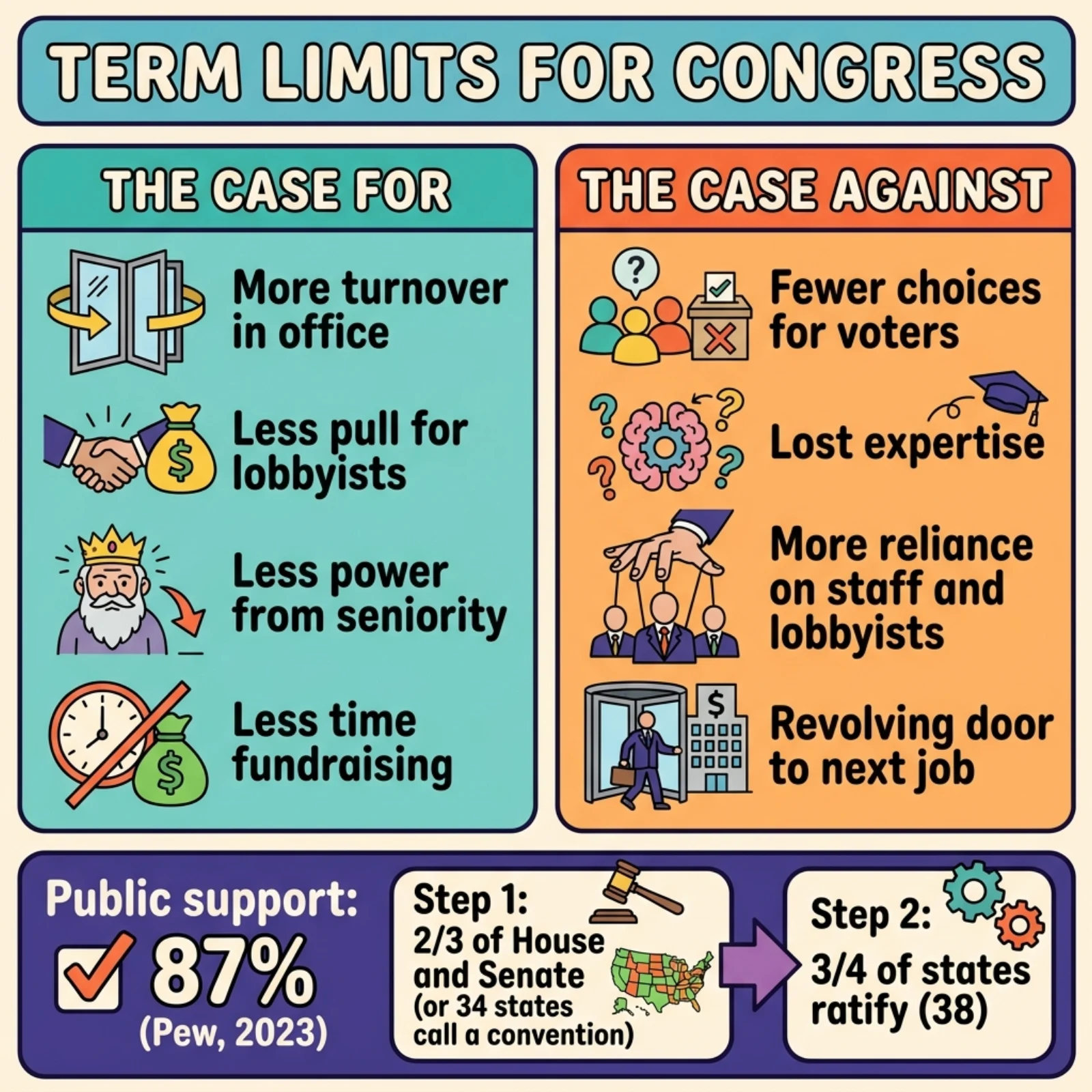
Few ideas in American politics get 87% approval. Term limits for Congress did, in a 2023 Pew Research Center survey, with support from 90% of Republicans and 86% of Democrats. And yet no House member or senator has ever been forced out by one. A representative can win reelection every two years for as long as the district keeps sending them back, and a senator can do the same every six.
That gap between public opinion and law has a simple cause: the Constitution sets the qualifications for the job, and only an amendment can add to them. This page lays out the arguments on both sides as their own supporters make them, then compares the routes a change could take. It doesn’t pick a winner. Proposals are current as of October 2026.
Why members of Congress have no term limits
Article I lists three qualifications for the House (age 25, seven years a citizen, living in the state) and three for the Senate (age 30, nine years a citizen, living in the state). It says nothing about the number of terms a member may serve.
In the early 1990s, 23 states tried to fill that gap themselves, mostly through ballot initiatives. Arkansas passed Amendment 73 in 1992, which kept anyone who had served three House terms or two Senate terms off the general election ballot. The case reached the Supreme Court as *U.S. Term Limits, Inc. v. Thornton*.
On May 22, 1995, the Court ruled 5-4 that a state cannot impose term limits or any other qualification beyond those in the Constitution, and that dressing the rule up as a ballot-access restriction didn’t change that. Justice John Paul Stevens wrote for the majority. Justice Clarence Thomas, in his dissent, argued that powers the Constitution does not take from the states remain with them and the people. Every limit a legislature had placed on its own federal delegation fell at once. Our explainer on how the Supreme Court works covers why one ruling reaches all fifty.

Two months earlier, the House had voted on its own version. H.J.Res. 73 got 227 votes to 204 on March 29, 1995, a majority but well short of the two-thirds required. No proposal of this kind has reached a floor vote in either chamber since that time.
The case for and against congressional term limits
Both camps want a Congress that works better. They disagree about whether experience is the cure or the disease.
| Question | What supporters say | What opponents say |
|---|---|---|
| Choice at the ballot box | Incumbents win most races, so elections alone rarely produce turnover | Limits take away the option to keep a lawmaker people like |
| Lobbyists and special interests | Rotating members breaks up long relationships with lobbyists and donors | New lawmakers lean more on lobbyists and staff, because they know less about policy |
| Experience | Newcomers bring outside careers instead of Washington habits | Writing laws on budgets, defense or health care takes years to learn |
| Seniority | Committee power stops piling up with the members who have served longest | Seniority rewards the most knowledgeable members in a policy area |
| Focus | Lawmakers who can’t run forever spend less time fundraising and more on long-term policy | A revolving door: members thinking about their next job may court future employers while in office |
| Balance of power | A citizen legislature, closer to how the founders pictured it | Congress loses ground to the president, the executive branch and career government staff |
Supporters often add that the political class in Washington has become too insulated, and that term limits are a way to bring more ordinary Americans into office. Opponents reply that the answer to an unpopular incumbent already exists, and it is called the next election.
Each side points to the states for evidence. Supporters note that term-limited legislatures see steady turnover and more open seats. Opponents cite political science studies of those same chambers that found more influence for staff, governors and lobbyists. Research supports both readings, and how much of it would carry over to Capitol Hill is disputed.
The 22nd Amendment: the model everyone cites
The president has had a limit since the 22nd Amendment. Congress passed it on March 21, 1947, and it was ratified on February 27, 1951. It caps a president at two elected terms. Supporters treat it as proof the idea works in the federal government; opponents answer that one executive is not the same as 535 lawmakers who need policy expertise. The full history is in our page on presidential term limits.
There is a certain irony in the process: a congressional limit needs two-thirds of the people it would limit to vote for it. Few employees get to approve their own exit date.
What it would take: three routes compared
After *Thornton*, the realistic paths all run through Article V of the Constitution.
| Route | How it works | Track record |
|---|---|---|
| Congress proposes | Two-thirds of the House and two-thirds of the Senate pass a joint resolution, then three-fourths of the states (38) ratify | All 27 amendments began this way |
| Convention of states | Two-thirds of legislatures (34) apply, Congress calls a convention, and its proposals still need 38 to ratify | Never used; no Article V convention has ever been called |
| Ordinary law | Legislatures or Congress set limits by statute | Blocked by *Thornton*; a federal statute would face the same qualifications problem |
Under the first route, a joint resolution does not go to the president for a signature, unlike an ordinary bill (see how a bill becomes a law for the usual path). Recent proposals give the ratification process a seven-year deadline.
The convention route is where advocacy groups such as U.S. Term Limits and the Convention of States Project put their effort, by asking legislatures to pass applications. Supporters see it as a way around a Congress that would have to vote against its own interest. Critics worry a convention could take up subjects beyond term limits, and the Constitution doesn’t spell out the rules for running one.
Current proposals in the 119th Congress
As of October 2026, the two main resolutions share the same design: three terms (six years) for House members and two terms (12 years) for senators.
- H.J.Res. 12, sponsored by Rep. Ralph Norman (R-S.C.), introduced January 6, 2025, with 115 cosponsors (107 Republicans, 8 Democrats). Its latest action is referral to the House Judiciary Committee, according to the resolution’s Congress.gov record.
- S.J.Res. 1, sponsored by Sen. Ted Cruz (R-Texas), introduced January 7, 2025, with 19 Republican cosponsors. It was referred to the Senate Judiciary Committee.
Neither has received a committee vote. Both count terms only from ratification onward, so no sitting member would be pushed out right away. Reaching 290 House votes and 67 Senate votes is a different matter, and our guide to how Congress works explains why committee referral is where most resolutions stop.
Term limits in state legislatures
States can limit their own lawmakers, and 16 do, according to the National Conference of State Legislatures. North Dakota is the newest, after a constitutional measure passed in 2022. Six others had limits that were repealed or struck down by courts. Legislative term limits have been studied for decades, which makes them the closest thing the federal debate has to a real-world test.
FAQ
Do members of Congress have term limits?
No. Representatives serve two-year terms and senators six-year terms, and both can run for reelection any number of times.
Can a state limit how long its own members of Congress serve?
No. The Supreme Court ruled in *U.S. Term Limits v. Thornton* (1995) that states cannot add to the qualifications in the Constitution.
Do Americans support term limits?
Yes, by wide margins. Gallup found about three-quarters support in January 2013, and Pew found 87% in 2023.
How could term limits for members of Congress become law?
Through a constitutional amendment, proposed either by two-thirds of both chambers or by a convention requested by 34 legislatures, then ratified by 38.
Sources
- Congress.gov: H.J.Res.12, 119th Congress (2025-2026), Proposing an amendment to limit the number of terms a Member of Congress may serve
- Legal Information Institute (Cornell Law School): U.S. Term Limits, Inc. v. Thornton, 514 U.S. 779 (1995)
- Pew Research Center: How Americans View Proposals to Change the Political System (September 2023)
- National Archives: The Constitution, Amendments 11-27 (22nd Amendment)