The short answer
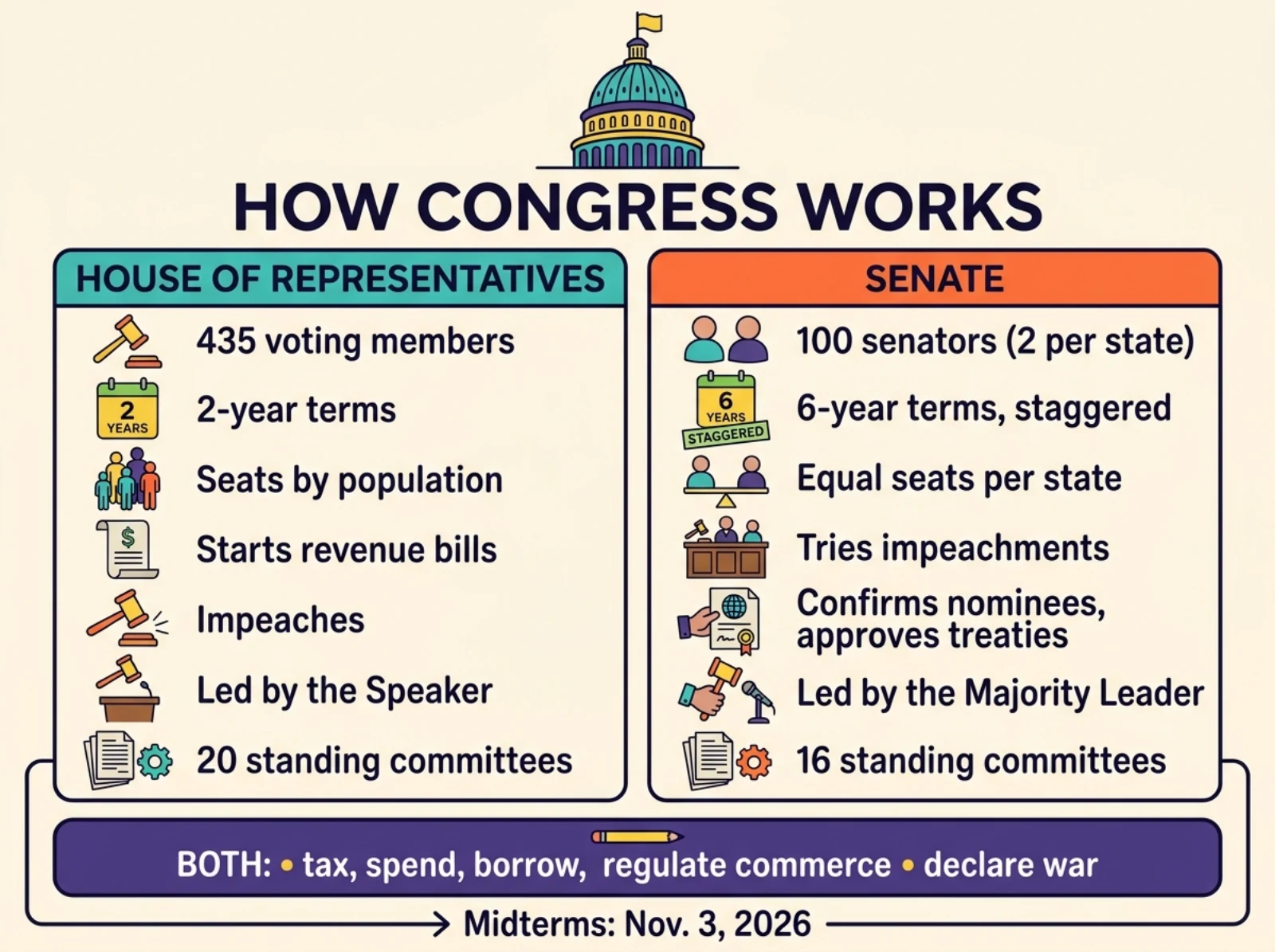
Congress is the legislative branch of the US government, made up of the House of Representatives (435 voting members elected every two years, with seats divided by population) and the Senate (100 senators, two per state, serving six-year terms). Both chambers must pass the same bill before it goes to the President, and each has its own powers: the House starts revenue bills and impeaches, while the Senate holds impeachment trials, confirms nominees and approves treaties.
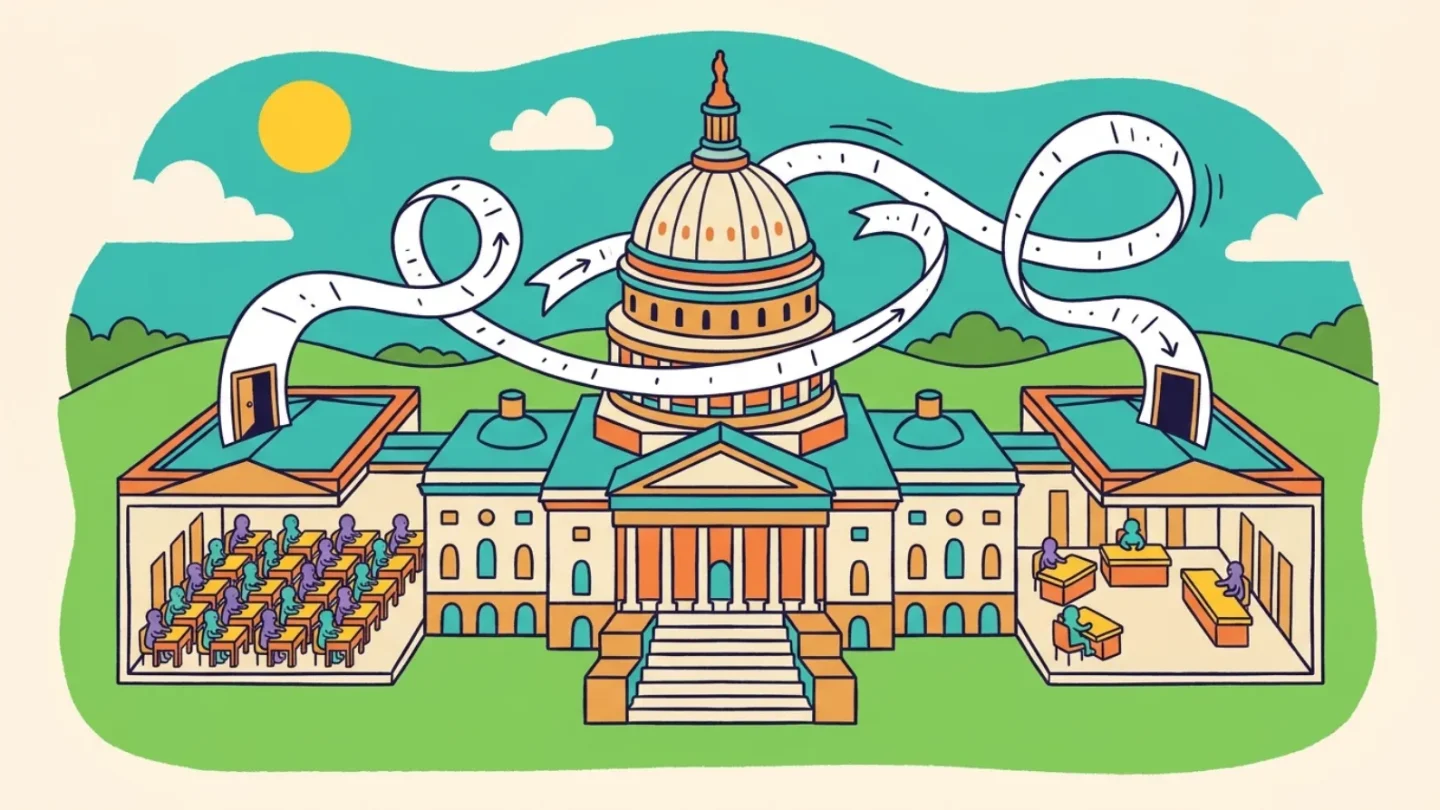
Congress is the first branch the Constitution describes. Article I comes before the presidency and the courts, and that order is a decent hint about how Congress works: the framers wanted the people’s representatives to write the laws and control the money, and they split the job between two bodies so neither could do it alone.
The United States Congress is the legislative branch of the federal government: 100 senators plus 435 voting members of the House of Representatives, 535 in total. Here is how it is built, what it can do, who runs it as of October 2026, and how to reach the people who represent you.
How Congress is built: the House and the Senate
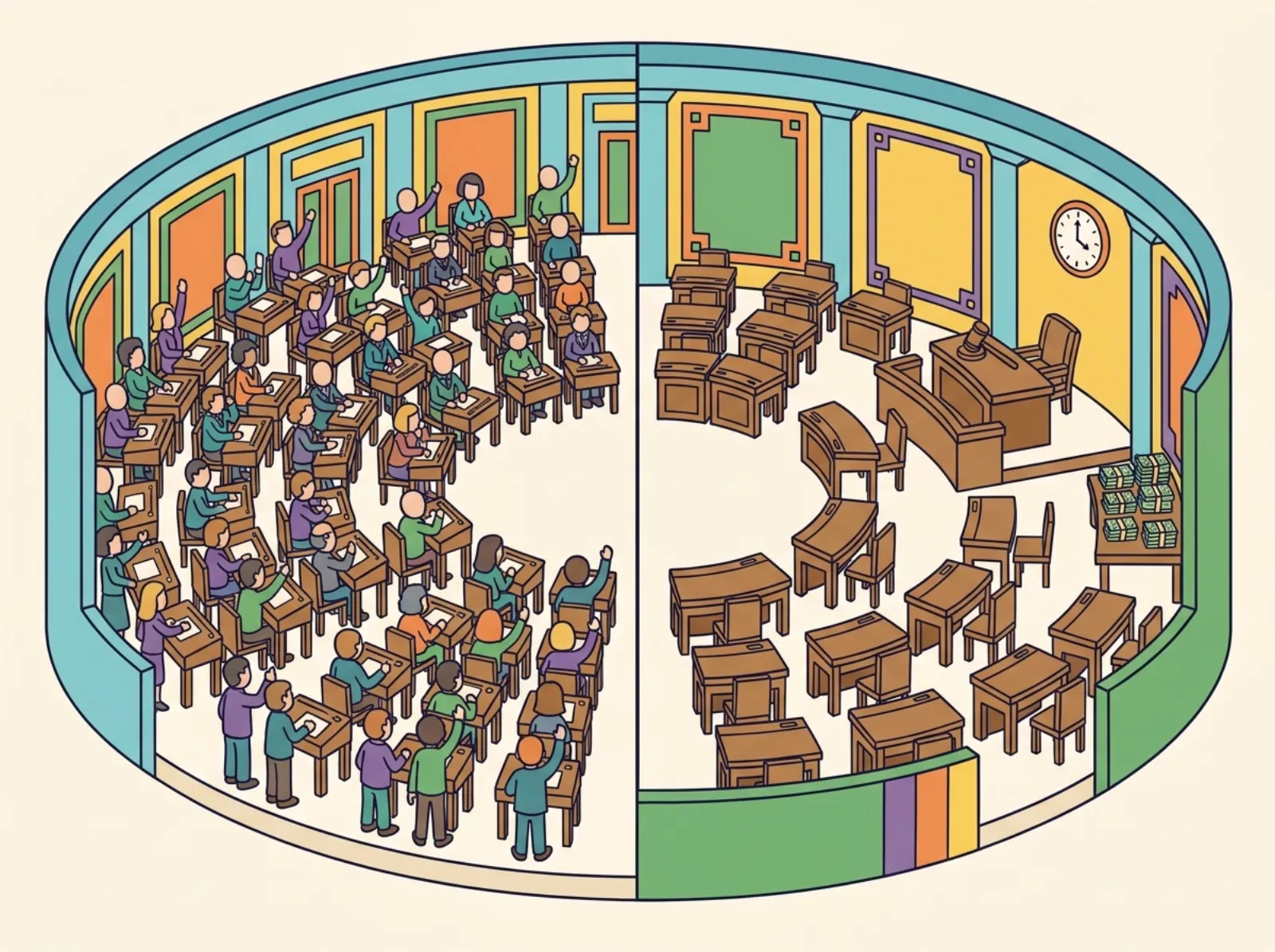
The House is meant to track the population. California has dozens of representatives; the least populous states have one. The Senate gives every state equal weight: two senators each, whether the state had fewer than 600,000 residents in the 2020 census, like Wyoming, or more than 39 million, like California.
| House of Representatives | Senate | |
|---|---|---|
| Voting members | 435 | 100 (2 per state) |
| Term | 2 years | 6 years, staggered |
| Minimum age | 25 | 30 |
| Years as a US citizen | 7 | 9 |
| Presiding officer | The Speaker | The Vice President |
| Party split, as of October 2026 | 218 R, 214 D, 1 independent, 2 vacant | 53 R, 45 D, 2 independents (caucus with D) |
The House also has six nonvoting members: delegates from the District of Columbia, Guam, the U.S. Virgin Islands, American Samoa and the Northern Mariana Islands, plus a resident commissioner from Puerto Rico. They sit on committees and debate on the floor, but they cannot vote when the full House passes legislation.
What powers does Congress have?
Congress has only the powers the Constitution gives it, but this list is long. Article I, Section 8 says Congress may:
- lay and collect taxes, pay the debts and borrow money,
- regulate commerce with foreign nations, among the states and with Indian tribes,
- coin money and set rules for naturalization and bankruptcy,
- declare war, raise armies and maintain a navy,
- create the federal courts below the Supreme Court,
- and make all laws “necessary and proper” to carry out those powers.
The spending power reaches furthest. Under Article I, Section 9, no money leaves the Treasury without an appropriation made by law, so every federal agency depends on Congress passing spending bills. Congressional oversight is the other big lever: committees hold hearings, demand documents and investigate how the executive branch carries out the laws Congress passed. Spending fights and oversight hearings are where most government policy gets argued in public.
Some powers belong to one side only:
- The House: all bills for raising revenue must start there (Article I, Section 7), and it has “the sole Power of Impeachment,” meaning it brings the charges.
- The Senate: it holds the impeachment trial, and conviction takes two-thirds of the senators present. It also gives “advice and consent” on the President’s nominees for judges, ambassadors and Cabinet posts, and approves treaties by a two-thirds vote (Article II, Section 2).
Every one of these clauses is in the National Archives transcription of the Constitution. For the route a proposal takes, see our step-by-step guide to how a bill becomes a law.
Who leads Congress? Speaker, leaders and whips
The Constitution names only a few officers: the Speaker, the Vice President as President of the Senate, and a president pro tempore who presides when the Vice President is away. Party leadership fills in the rest, and both chambers organize it the same basic way. Names below are as of October 2026.
- Speaker of the House: elected by the full House, in practice the majority party’s leader. The Speaker decides which bills reach the floor. Currently Mike Johnson, a Louisiana Republican.
- House floor leaders: Steve Scalise runs floor strategy for the majority, Hakeem Jeffries for the minority.
- Senate majority leader: the most powerful senator, because the job comes with setting the floor schedule and being recognized first. Currently John Thune, a South Dakota Republican; Chuck Schumer heads the minority.
- Whips: they count votes and round up their colleagues before big roll calls. Senate whips are John Barrasso (majority) and Dick Durbin (minority).
The Vice President rarely presides day to day but can break a tie. And a Senate majority can’t always act alone: most legislation needs 60 votes to end debate, the rule behind the filibuster.
How does Congress work in committees?
Neither chamber could read every proposal on the floor, so both chambers split the work among committees. The House has 20 standing committees and the Senate 16, plus select and joint committees. Agriculture handles farm policy, Armed Services defense policy, and Ways and Means (House) and Finance (Senate) handle taxes.
Committees hold hearings, rewrite bills in “markup” sessions and decide which ones go to the floor. Most introduced bills never get a committee vote. Think of it as the place where bills go to be studied, and where many stay. The majority party holds every chair and most seats, which is one reason control of a chamber matters. The House Rules Committee is special: it sets the terms of floor debate for most major bills, so its 13 members shape what the whole House votes on.
Elections and terms: 2 years versus 6 years
House members serve two-year terms, so every seat is on the ballot every two years. Senators get six, staggered so about one-third of the Senate is up in each election. Neither chamber has term limits, a debate we cover in our piece on term limits for Congress.
House seats are reapportioned after each census, which the Constitution requires every ten years. The Permanent Apportionment Act of 1929 capped the House at 435 and made the reshuffle automatic, so some states gain seats and others lose them. Today’s map rests on the 2020 census; the next reapportionment follows the 2030 count. Since the 17th Amendment (1913), voters have elected senators directly instead of state legislatures.
The next election is close. The midterms are on November 3, 2026, with all 435 House seats and 35 Senate seats on the ballot (33 regular seats plus special elections in Ohio and Florida). The new Congress is sworn in on January 3, 2027, so the leadership and numbers above may change.
How to contact your representative and senators
Lawmakers keep offices in Washington and back home, and their staff track what constituents say. A few practical tips:
- Find out who represents you. Enter your ZIP code at house.gov under “Find Your Representative”; senate.gov lists your two senators by state.
- Call. The U.S. Capitol switchboard at (202) 224-3121 connects you to any House or Senate office. District offices are often easier to reach.
- Write or email through the contact form on the member’s website, and include your address so the office knows you’re a constituent.
- Be specific. Name the bill number if you can (H.R. or S. plus a number), say what you want and keep it short. Staff often tally messages by issue.
- Show up at town halls or district office meetings, where you get time face to face.
Organized interests do the same thing at scale, which is a big part of what lobbying is. A constituent who calls is doing a small version of it for free.
Key takeaways
- Congress has two parts: the House of Representatives and the Senate. The House has 435 voting seats split by population, all elected every two years; the Senate has 100 seats, two per state, with six-year terms.
- Article I lets Congress tax, spend, borrow, regulate commerce and declare war. The House starts revenue bills and impeaches; the Senate tries impeachments, confirms nominees and approves treaties.
- As of October 2026, Republicans hold majorities in both chambers, with Mike Johnson as Speaker and John Thune as Senate majority leader.
- Committees do most of the detailed work and decide which bills reach the floor.
- House seats are reapportioned after every census. All 435 House seats and 35 Senate seats are on the ballot on November 3, 2026.