 By
The short answer
A filibuster is any tactic, classically a marathon speech, that keeps the US Senate from ending debate so a measure can't come to a vote. Ending it takes cloture, which for most legislation requires 60 of 100 senators. Nominations (since 2013 and 2017) and budget reconciliation bills can pass with a simple majority.

At 8:54 p.m. on August 28, 1957, Senator Strom Thurmond of South Carolina stood up on the Senate floor to speak against the Civil Rights Act of 1957. He sat down 24 hours and 18 minutes later. In between, he read the election laws of all 48 states, the Declaration of Independence and the Bill of Rights.
The bill passed anyway, shortly after he finished. The speech still became the most famous answer to the question “what is a filibuster?”: a senator keeps talking so the chamber can’t get to a vote. Thurmond’s mark for the longest individual speech stood for almost 68 years, until Senator Cory Booker of New Jersey spoke for about 25 hours in April 2025. Booker wasn’t blocking a particular measure, which shows how loosely the word gets used.
What Thurmond’s speech shows about how a filibuster works
The House of Representatives limits how long members may speak. The Senate, for most of its history, did not. Once recognized, senators can hold the floor, and as long as debate isn’t over, nobody votes. Anything that drags out debate to block or delay action counts as filibustering.
Senators have used several tools:
- long speeches, the classic version Thurmond made famous,
- offering one amendment after another, with more amendments waiting,
- demanding quorum calls and roll call votes,
- objecting to the “unanimous consent” agreements the Senate uses to move quickly,
- and simply announcing a filibuster threat, which today is usually enough.
The word itself is older than the rule. According to the Senate Historical Office, “filibuster” comes from a Dutch word for “pirate” and became popular in the 1850s.
How many votes does it take to end a filibuster?
From 1789 to 1917, there was no rule to cut off debate. A filibuster ended by unanimous consent, by compromise, or when the talkers were exhausted. Then, in early 1917, a small group of senators talked to death a measure to arm merchant ships before World War I. President Woodrow Wilson called them “a little group of willful men,” and the Senate adopted Rule XXII, the cloture rule, that March.
The threshold has changed a few times since, but the Senate has kept the basic idea:
| Year | What changed | Votes needed to end debate |
|---|---|---|
| 1917 | Rule XXII creates cloture | Two-thirds of senators present and voting |
| 1975 | Threshold lowered for most matters | Three-fifths of senators duly chosen and sworn, normally 60 |
| 2013 | “Nuclear option” on nominations, except the Supreme Court | Simple majority for those nominations |
| 2017 | Same precedent extended to Supreme Court nominations | Simple majority |
Changing the rules themselves still takes two-thirds of senators voting. In the four decades after 1917, cloture succeeded only five times.
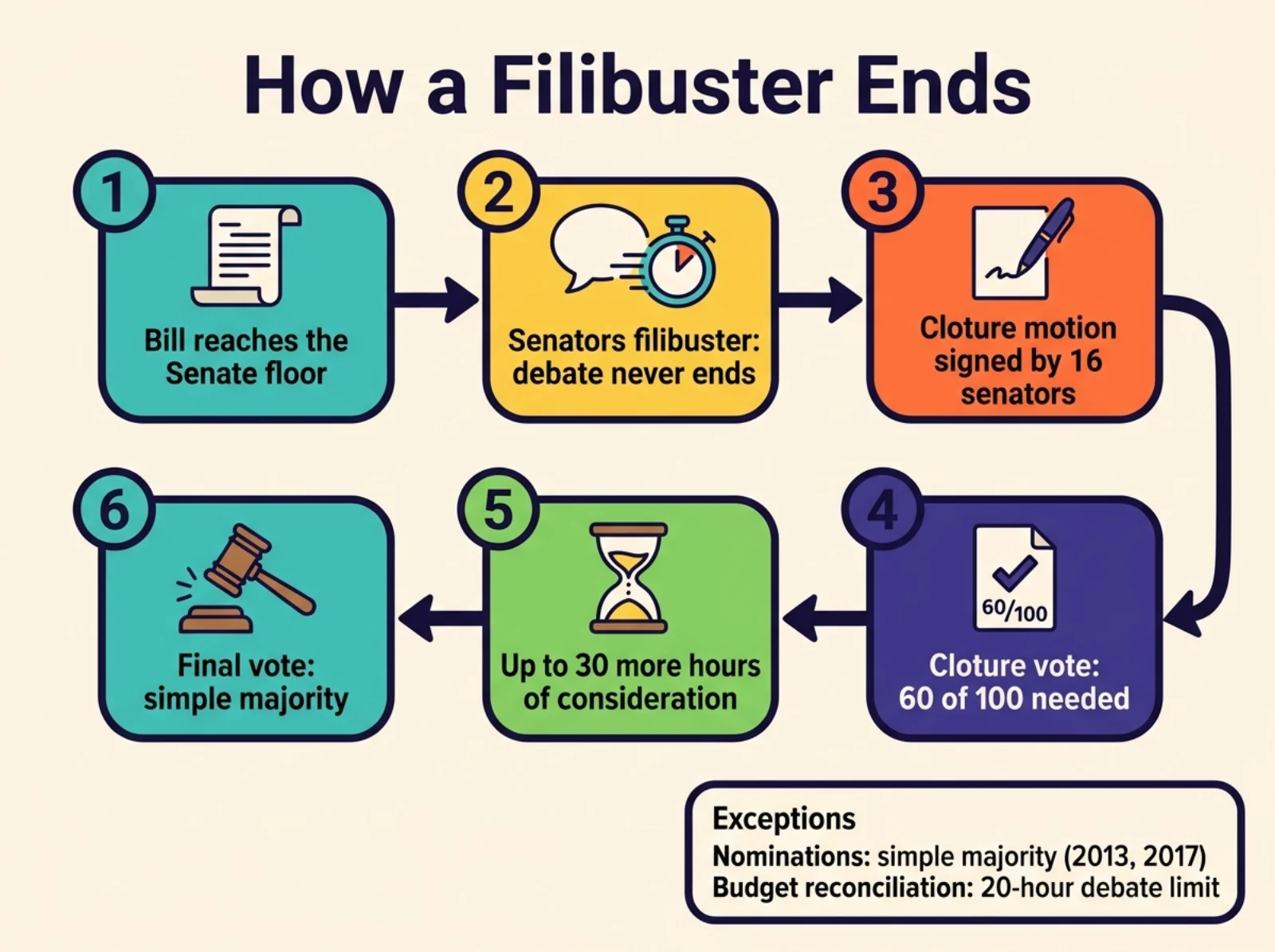
Here’s how it works today, according to the Congressional Research Service. Sixteen senators sign the cloture motion, and the vote comes after an intervening day. If the cloture vote reaches three-fifths, consideration is limited to 30 more hours. Cloture doesn’t pass anything. It ends the talking, and the measure still needs a final vote.
What is the difference between a talking and a silent filibuster?
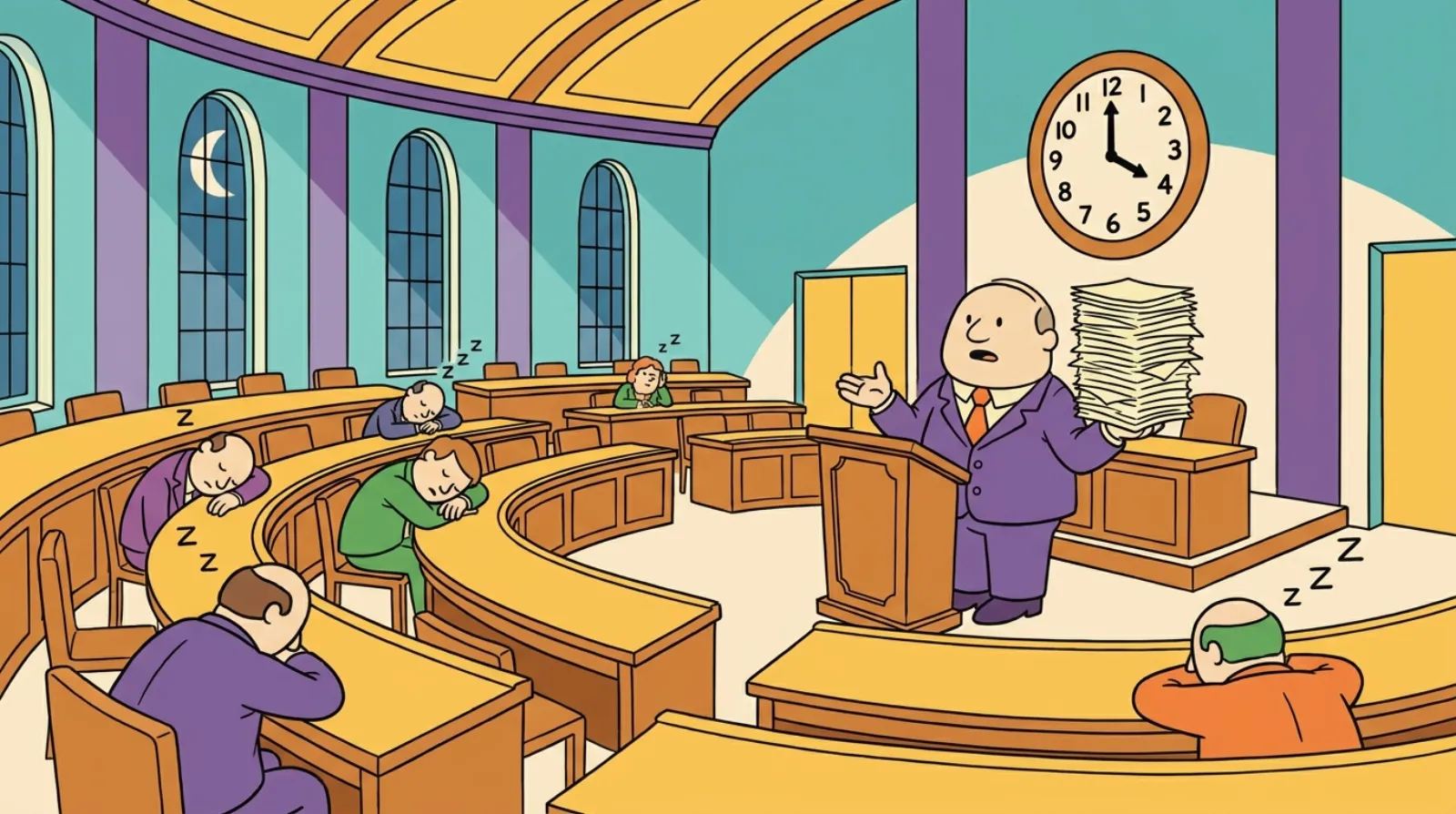
Thurmond’s speech is the image most people have, but it is rare now. Starting in the early 1970s, leaders began running a “two-track” system: a filibustered measure is set aside while the chamber works on other business. That kept the Senate from grinding to a halt, and it also made filibustering cheap.
The result is the “silent” filibuster. A senator, or more often the minority party, signals opposition, and the Senate Majority Leader knows nothing moves without 60 votes. Nobody has to stand at a lectern overnight. In practice, the filibuster now works less like a speech and more like a standing 60-vote requirement for most legislation.
| Talking filibuster | Silent filibuster | |
|---|---|---|
| What senators do | Hold the floor in person, hour after hour | Signal opposition; the bill is set aside |
| How it ends | They give up, or cloture is invoked | Only when 60 senators vote for cloture |
| Cost to the minority | Sleep, stamina, a strong bladder | Almost none |
This is why “bring back the talking filibuster” keeps coming up as a reform idea. Supporters say it would make obstruction cost something. Skeptics point out that it would also eat up floor time needed for everything else.
What is the nuclear option, and what else skips the 60 votes?
The filibuster has holes, and both parties have made some of them.
Nominations
In November 2013, Democrats, then in the majority, used the nuclear option: they overruled the chair to set a precedent that cloture on executive and lower-court nominees needs only a simple majority. In April 2017, Republicans did the same for Supreme Court picks. In September 2025, Senate Republicans set another precedent so certain executive nominees can be confirmed in groups.
Budget reconciliation
Under the Congressional Budget Act of 1974, debate on a reconciliation bill is limited to 20 hours. Because time runs out on its own, no cloture vote is needed and 51 votes can pass it. The catch is the Byrd rule, which keeps “extraneous” provisions out. That’s why big tax and spending packages often travel this route and many other policies can’t.
For most legislation, though, the 60-vote bar is still the rule, a point covered in our walkthrough of how a bill becomes a law.
Can the filibuster be eliminated? Both sides of the debate
Democrats and Republicans have each argued both sides of it, depending on who held the majority. Here are the main arguments, in each side’s own terms.
Arguments for keeping it:
- It protects the minority party and forces the majority to build broader coalitions.
- Laws passed with 60 votes usually have support from both parties, which supporters say makes them more durable.
- The Senate was meant to be the slower chamber, and the filibuster keeps it that way.
- Today’s majority will be tomorrow’s minority.
Arguments for ending or changing it:
- Voters elect a majority to pass its agenda, and a 60-vote bar lets a minority block it.
- The silent filibuster makes blocking a bill almost costless.
- The rule has a long history of being used against civil rights legislation, including the bill Thurmond tried to stop.
- The exceptions for nominations and reconciliation show the chamber can function without it.
Eliminating the filibuster outright would require changing Rule XXII or setting a new precedent by majority vote, the same way the 2013 and 2017 changes happened. For how the chamber fits into the wider system, see how Congress works, and for where each party stands on issues, our guide to Democrats vs. Republicans.
Where things stand as of October 2026
As of October 2026, the legislative filibuster is still in place. President Donald Trump has repeatedly urged Senate Republicans to eliminate it, but Majority Leader John Thune has said his conference doesn’t support eliminating the filibuster. Some Democratic Senate candidates say they would end it if their party wins control, and others haven’t committed.
In early October 2026, Senators Jeff Merkley (D-Ore.) and Steve Daines (R-Mont.) floated a bipartisan proposal to speed up floor action. It would cut post-cloture time from 30 to 12 hours for certain bills and fast-track broadly bipartisan legislation while keeping the 60-vote threshold for final passage. It has not been adopted. The Senate’s own overview of filibusters and cloture lays out the current rules.
Key takeaways: what is a filibuster?
- A filibuster is any tactic that delays or blocks a Senate vote by preventing debate from ending.
- Cloture, under Rule XXII since 1917, now takes 60 votes for most legislation (two-thirds until 1975).
- Marathon speeches like Thurmond’s 24 hours and 18 minutes are rare; usually, the threat alone sets a 60-vote bar.
- Nominations need only a majority since 2013 and 2017, and budget reconciliation is limited to 20 hours of debate.
- The House has no filibuster, because its rules limit debate.
- Supporters call it a protection for the minority, critics call it minority rule, and as of October 2026 it is still standing.