 By
By The short answer
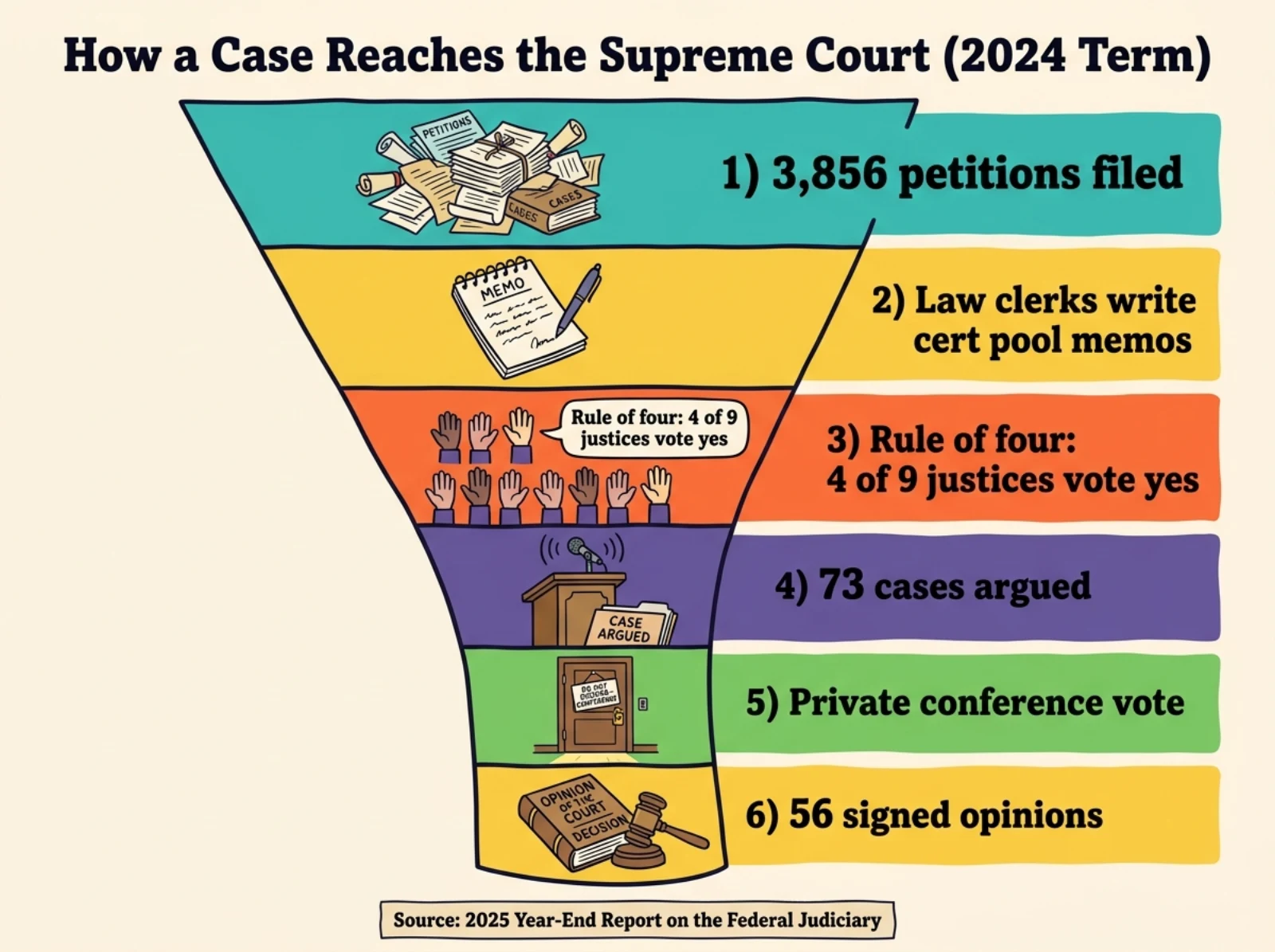
The Supreme Court picks most of its own cases: losing parties file petitions for certiorari, and the Court hears a case only if four of the nine justices agree, which happened 73 times out of 3,856 filings in the 2024 Term. Justices are nominated by the President, confirmed by the Senate and serve for life. After written briefs and an hour of oral argument, they vote in private and issue majority, concurring and dissenting opinions that bind every lower court.
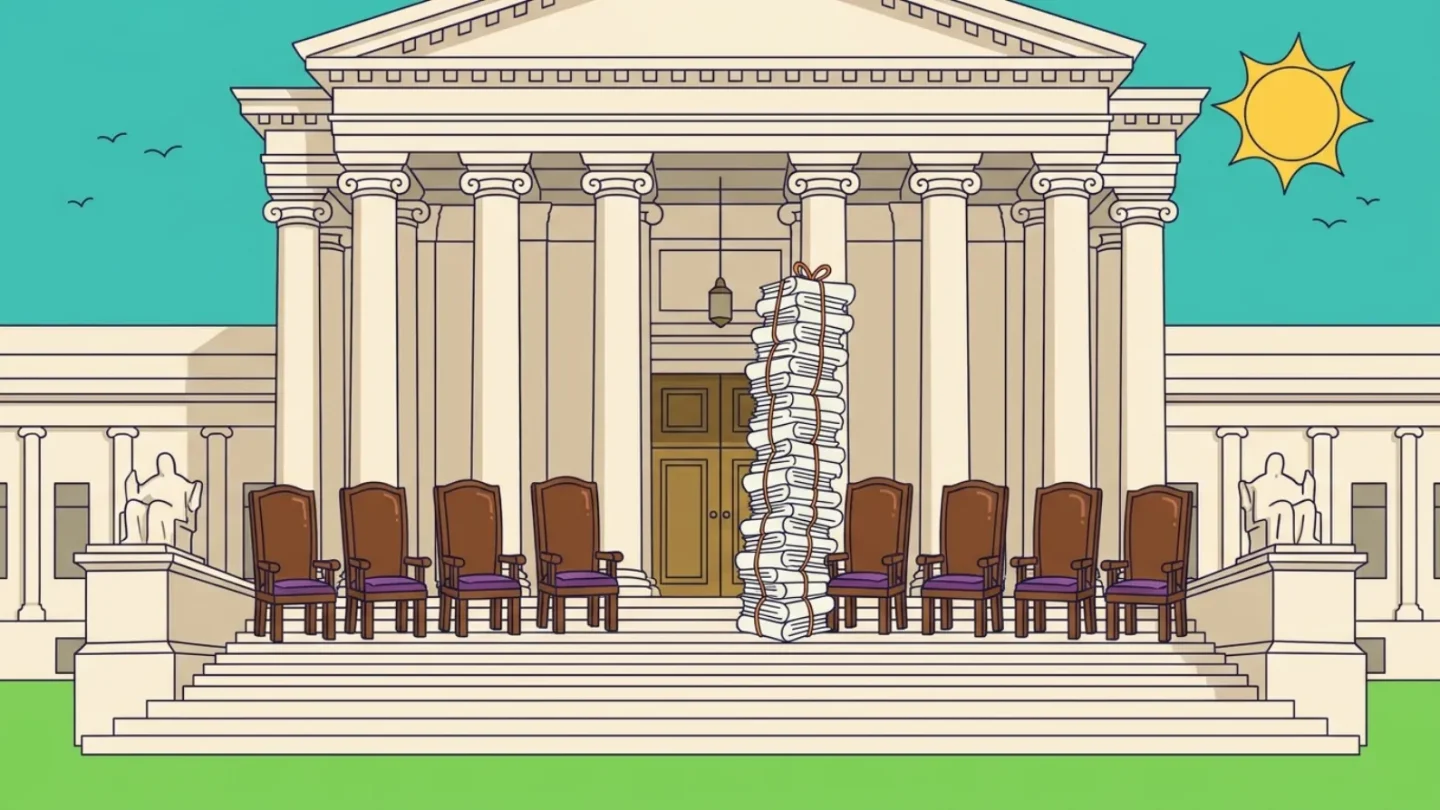
In its 2024 Term, the highest court in the United States received 3,856 new cases. It heard oral argument in 73 of them, under 2 percent. So how does the Supreme Court work? Mostly by saying no. Once a case gets in, nine justices read the briefs, hear an hour of argument, vote in private and then write, sometimes for months.
The questions below follow the path a case actually travels.
How do cases get to the Supreme Court?
Almost every case starts in a lower court. A party that loses in a federal court of appeals or a state’s highest court, the petitioner, asks the justices to take another look by filing a petition for a writ of certiorari, or “cert petition.” If the Court grants certiorari, it orders the lower court to send up the record of the case.
Most petitions fail. The justices review about 130 petitions a week, and law clerks in the “cert pool” write short memos on each one. Then the justices vote at a private conference.
The 2024 Term in numbers:
| What happened | Number |
|---|---|
| New cases filed | 3,856 |
| Filed by people who could not pay the fee (in forma pauperis) | 2,527 |
| Filed on the paid docket | 1,329 |
| Cases argued | 73 |
| Signed opinions in argued cases | 56 |
These figures come from the Chief Justice’s 2025 Year-End Report on the Federal Judiciary. The year before, it received more: 4,223 filings and heard 69 arguments.
What is the rule of four?
To grant cert, the justices must have four votes out of nine. It is a custom rather than a written law, and it lets a minority put a case on the calendar that the majority might rather skip. The justices typically take cases that involve lower courts disagreeing on the same legal question, or where the stakes for the Constitution or federal law are high. A denial sets no precedent. It leaves the lower court’s decision in place.
A few cases skip this step. Under Article III, disputes between two states, and some between states and the federal government, fall under the Court’s original jurisdiction, which means they start at the top.
How are Supreme Court justices chosen?
The Constitution’s recipe is short. Under Article II, the President nominates and the Senate gives “Advice and Consent.” In practice:
- A seat opens through death, retirement or resignation.
- The President announces a nominee.
- The Senate Judiciary Committee holds hearings and votes.
- The full Senate confirms or rejects the nominee by a simple majority. Since 2017 a filibuster can no longer block a Supreme Court nominee.
Article III says judges hold office “during good Behaviour,” which works out to lifetime tenure. A justice leaves by dying, retiring or being impeached and removed, and no justice has ever been removed. The House impeached Justice Samuel Chase in 1804. The Senate acquitted him in 1805.
As of October 2026, John G. Roberts Jr. has been Chief Justice since 2005. The associate justices are Clarence Thomas, Samuel A. Alito Jr., Sonia Sotomayor, Elena Kagan, Neil M. Gorsuch, Brett M. Kavanaugh, Amy Coney Barrett and Ketanji Brown Jackson, who joined on June 30, 2022. Six were nominated by Republican presidents and three by Democratic presidents.
Why are there nine justices?
Because Congress said so. The Supreme Court has had nine seats since 1869. The Constitution never sets a number. The Judiciary Act of 1789 created a Court of six, and the size changed six times, peaking at ten seats in 1863 and dropping to seven in 1866, before the Judiciary Act of 1869 settled it at nine, one for each federal circuit at the time. Every later attempt to change the number, including Franklin Roosevelt’s 1937 plan, has failed. Since a statute sets the size, Congress could still change it, which is why the debate never quite ends.
What happens at oral argument?
By law, each term begins on the first Monday in October. Arguments usually run Monday through Wednesday from October to April, and with rare exceptions each side gets 30 minutes.
The justices have already read the written briefs, plus “friend of the court” briefs from outside groups, so argument is mostly questions. Lawyers often get a sentence or two of their prepared remarks in before a justice cuts in with a hypothetical. Since 2021, each justice also gets a turn in order of seniority near the end of each lawyer’s time.
Cameras are not allowed in the courtroom. The Court posts audio recordings, and for pictures the country relies on sketch artists, a job that has otherwise mostly disappeared from American life.
How are decisions written?
After the argument, the justices meet in conference. They speak in order of seniority, starting with the Chief Justice, and each justice states a vote. Nobody else is in the room, not even clerks.
If the Chief Justice is in the majority, he assigns who writes the opinion. If not, the most senior justice in the majority decides. Drafts circulate for weeks or months, and votes can shift. The decision can include three kinds of opinions:
- The majority opinion is the Court’s ruling, and lower courts must follow it. A majority of justices must agree to all of its contents.
- A concurring opinion agrees with the result but gives different or extra reasoning.
- A dissenting opinion disagrees with the outcome. Dissents have no legal force, though some get quoted years later when the Court changes course.
Most big decisions arrive in May and June.
What is judicial review?
Judicial review is the power of courts to strike down a law or government action that conflicts with the Constitution. The text does not spell it out. The Court claimed it in Marbury v. Madison (1803), where Chief Justice John Marshall wrote that “it is emphatically the province and duty of the judicial department to say what the law is.” The same opinion held that “a law repugnant to the constitution is void.”
This is the main way that the Supreme Court checks Congress and the President. If you want the other side of that relationship, see how Congress works.
Can Supreme Court decisions be overturned?
Yes, in three ways:
- The Court overrules itself. Brown v. Board of Education (1954) rejected the “separate but equal” doctrine of Plessy v. Ferguson (1896). Dobbs v. Jackson Women’s Health Organization (2022) overruled Roe v. Wade (1973).
- A constitutional amendment overrides a ruling. The 11th Amendment reversed Chisholm v. Georgia (1793), and the 14th Amendment undid the citizenship holding in Dred Scott v. Sandford (1857).
- Congress rewrites a statute the Court has interpreted. After Ledbetter v. Goodyear (2007), Congress passed the Lilly Ledbetter Fair Pay Act of 2009, following the usual path of how a bill becomes a law.
People on both sides of a given precedent disagree about when overruling is justified. The Court’s doctrine of stare decisis says it should depart from precedent only for a strong reason.
Supreme Court FAQ
How many cases does the Supreme Court hear each year?
Recently about 70 argued cases a year: 69 in the 2023 Term and 73 in the 2024 Term, out of roughly 4,000 filings.
How long do justices serve?
For life, or until they choose to retire. The Constitution sets no term limit or retirement age.
Who is the Chief Justice?
As of October 2026, John G. Roberts Jr., who took office on September 29, 2005. He is the 17th Chief Justice.
What are the most famous Supreme Court cases?
Marbury v. Madison (1803), Dred Scott v. Sandford (1857), Brown v. Board of Education (1954), Miranda v. Arizona (1966, the source of the “right to remain silent” warning) and Roe v. Wade (1973) are among the most taught.
Can the President overrule the Supreme Court?
No. A President can nominate justices when seats open and push for new legislation or an amendment, but cannot reverse a ruling alone.